
The engagement gap: How RubyPlay is doing Missions and Tournaments differently
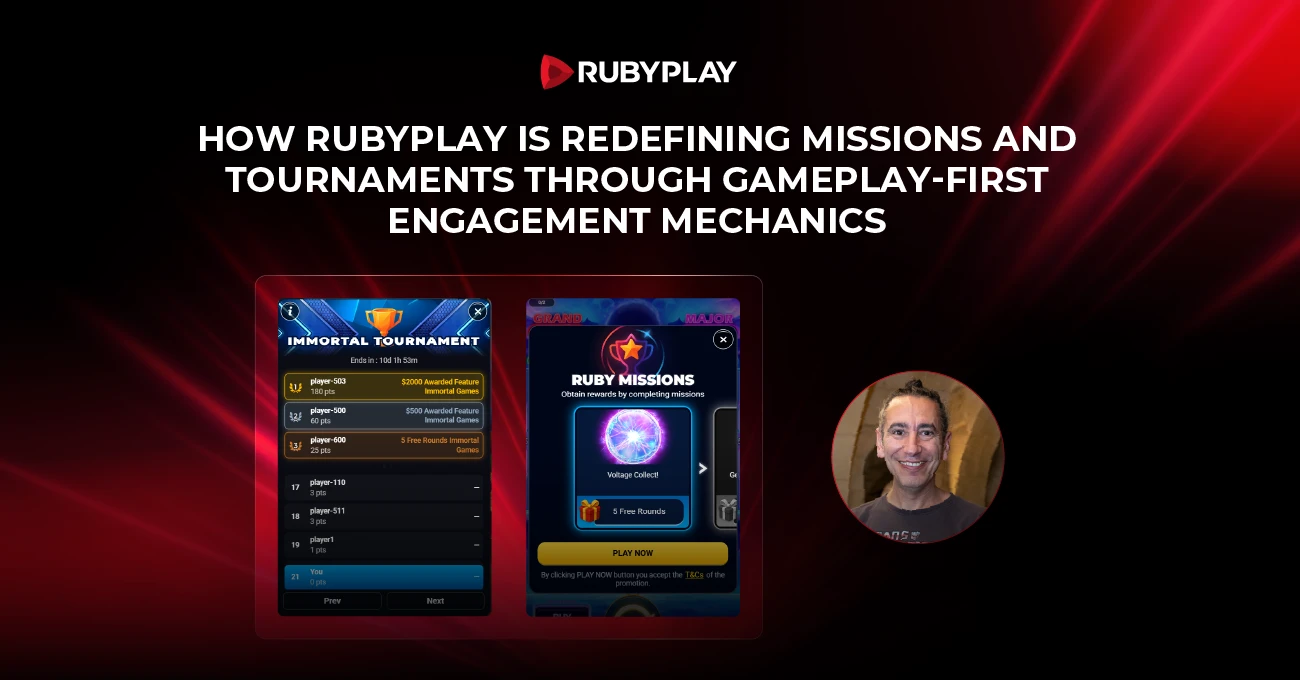
iGB: Missions and Tournaments are not new concepts in iGaming, so what’s RubyPlay’s point of difference here, and why does it matter?
Eyal Loz: Most of what exists in the market today is a variation of the same mechanic: reward the highest-value, crown the biggest winner, and repeat. The tools are transactional, with engagement often driven more by promotional mechanics than gameplay interaction. What we’ve built is fundamentally different because it’s anchored to what happens inside the game, such as symbols landing, features triggering, gameplay unfolding in real time. That shift might sound incremental, but strategically it’s enormous. You’re no longer rewarding a player for having a larger bankroll, instead rewarding them for as they enjoy the core experience itself. That’s a more exciting and sustainable proposition for everyone involved. Because game events are game specific, and not generic, we drive engagement through the core experience of the game, and we use engagement to reinforce the core experience of the game.
Walk us through how in-game engagement mechanics differ from traditional wallet-based options. Why is that distinction so significant?
Wallet-based mechanics are a proxy for engagement, meaning they measure spend and assume the rest. In-game events are the real engagement. When we build a Tournament around which players trigger the most feature activations, or land key symbols, even with no win events, we’re measuring moments that are genuinely happening in the session. The most important moments!
It’s richer data and therefore creates a richer experience. There’s also a fairness dimension that I think is underappreciated. Wallet-based mechanics are inherently skewed toward high-rollers. A player with a modest budget but strong engagement and session depth loses out, which means you’re not actually retaining your broader player base. Our approach opens the competitive layer to the full player population, which is where the real retention opportunity sits.
Your background is in social casino, which has long led the way on gamification and metagame engagement. How far behind is iGaming in that regard, and what can operators learn from the social casino playbook?
The gap is wider than most people in the industry want to admit. Social casino had to solve retention through pure product design as there’s no real-money prize to fall back on, so if your metagame engagement layer isn’t compelling, players will simply leave. That constraint forced genuine innovation via progression systems, mission structures, layered objectives and community competition. All of it was built because the gameplay experience had to be enough on its own. iGaming has largely used monetary reward as a substitute for that kind of design thinking. It works as a short-term retention tool, but it’s expensive and it doesn’t build the level of player connection that drives long-term loyalty. The operators who recognise that and start borrowing from the social casino playbook will have a significant structural advantage.
Both Missions and Tournaments will be embedded across every studio within the RubyPlay ecosystem. What does that mean for an operator activating these tools and why was that unified, portfolio-wide approach so important to get right from the outset?
Game event based CRM activity is difficult to design and build: the probability of specific game events changes from one game to the next. The art and key symbols change from one game to the next. This is not a game agnostic solution. That complexity is why iGaming is not an early adopter of in-game event products; iGaming suppliers choose to develop wallet events instead. For us, however, this presented an opportunity, especially when we saw that in-game event engagement systems can improve player retention by more than 30% in the social casino context.
For this to work, however, we had to make sure all games made by all studios across the RubyPlay ecosystem support game events seamlessly. Operators can connect directly to our Event API and enrich their existing CRM tools with more engaging missions or use our in-house missions and tournaments engine.
What are you seeing in the data, and what does success actually look like for an operator deploying these tools?
The KPI is simple. Either we can change player habits in a statistically significant way, or we can’t. Early results show that players who were given missions with targets over 20% above their habit, had over 70% completion rate. In other words, this is not just statistically significant, this is a game changer.