
Cubeia’s road to AI-assisted code: Chapter one
AI has become prolific across the gaming sector, in the form of customer-facing chat bots, marketing content, even gaming content. The value of artificial intelligence in such a fast-paced and ever-evolving industry as this is broadly understood.
Game developers like Playtech have talked up the potential for AI in leveraging its legacy gaming content and using player data to produce new AI-developed games that will appeal to long-standing players.
One supplier has gone a step further. Cubeia, an iGaming platform provider based in Stockholm has set itself the target of replacing its code with AI-written code, for all new features and releases. The challenge is to complete the task by August.
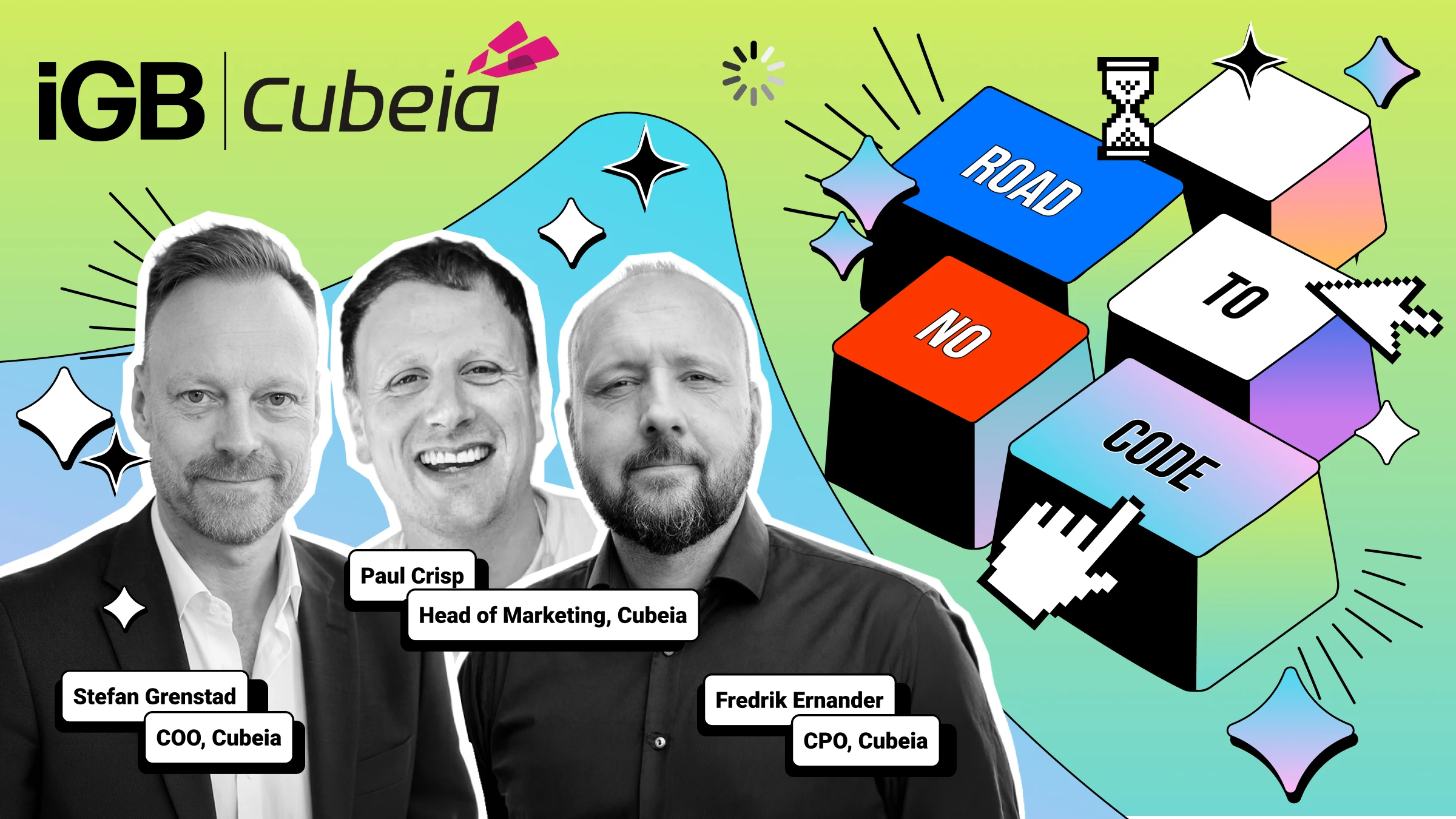
The idea struck Cubeia Chief Operating Officer Stefan Grenstad during a routine salary review. As he was pulling logs from project management tool Jira to prepare year-end assessments, a pattern jumped out of the data.
Tripling Cubeia’s output
The company’s mid-level software developers, who had historically delivered less than the seniors, were suddenly out in front. Not by a margin, but by a multiple. “Two or three developers were delivering almost 60% of the results,” Grenstad says. “It was AI allowing them to do it.”
For Grenstäd, just increasing the developers’ access to AI tools was “aiming too low”, he tells iGB. “We need to have this as an [integrated] part of how we do things,” he adds. From a business perspective, the value of increasing its output by three times through AI-written code made the decision an easy one.
“If we can have our mid-level [developers] delivering so much results, we would almost triple our output and then it becomes a survival question. If this company wants to survive with the competition, and everyone else can do three times the output, yeah, then we need to come along,” Grenstad says.
From a technical perspective, the shift is being implemented across both the supplier’s back and front-end code. Cubeia Chief Product Officer Fredrik Ernander says Claude is the primary LLM in use, but he is also experimenting with other tools like UX Pilot AI and v0.dev.
“It’s a much faster feedback loop,” he says of the use of AI. “I use these tools mainly for prototyping. When I want to communicate an idea to the teams, it helps to have a prototype in front of us. “Previously I would have pulled in a front-end developer to mock something up – to draft an interface that explained the idea – and now I can do that myself.”
Updating a flawed system
Grenstad is careful not to frame this as a headcount play. The real prize, he argues, is finally getting agile to behave like agile. Before implementing LLMs into the development process, the pipeline for front-end development, Grenstäd says, was dominated by two-week sprints. For two decades, two-week sprints have promised tight feedback loops and delivered something closer to assembly lines.
“We take from a backlog that’s owned by the product owner and he decides what to develop. [This process] has never really worked because when you’re done after two weeks you don’t really have the time to look at it again. So it goes out to production and off it goes. Hopefully it went well,” he explains.
AI-assisted development reframes that concern. “If somebody says ‘I want a blue button [added to my product],’ we ask, ‘what problem are we trying to solve?’” A feature that used to spend a fortnight in the pipeline can now ship the same afternoon, get used, get critiqued and be rewritten before the day is out. “In one day maybe we can have three or four iterations,” the COO says.
In his internal pitch to the development team Grenstad leaned heavily on competitive survival. But for those sceptical of the change, and concerned about the possibility of cutting down on human developers, he is reassuring. “I spent a lot of time on the why, and the why is about being competitive in the market, and also for me [it’s about being agile] and actually building something that is needed,” he insists. While some of the development team are driving this change, he says the senior staffers remain sceptical.
Human intervention still needed
He is adamant that human intervention is still required in the process, particularly to review code as it is processed by the LLM. “The review phase is big. We need to make sure that AI is not hallucinating or making assumptions that are not correct. So we need to be reviewing a lot over time. [In time] I guess we will trust it more and not review so much,” says Grenstad.
Ultimately Cubeia’s customers will be the deciding factor for whether the transition is deemed a success. While customer updates will come hard and fast, CPO Ernander says he does not anticipate there to be an overall improvement of speed to market in the early stages. “The actual time spent on coding, which used to be the main [time consuming] factor, isn’t the main factor anymore. The main factor now is the discussion of scope and definitions – how something is supposed to work and how it interacts with the legacy parts of the platform. Do we change parts of the legacy code to improve the product for the future? It’s much more on that level now,” he adds.
As Ernader alludes to, a big challenge throughout the process is ensuring AI-written code can sit alongside the legacy human-written code. But once these hiccups are ironed out, Ernander says he expects speed to market to improve dramatically. “If I look into the crystal ball, I see everything speeding up because we’re not spending as much time on the actual code development. We’re spending much more time defining what we’re delivering.”
Industry AI adoption
Notably he believes that competitors are taking similar steps with their own AI use. “But Cubeia is early and we’ve moved fast. So we are ahead.” In five years he expects AI to drive game development, as previously hinted at by Playtech CEO Mor Weizer. Weizer recently told analysts during the company’s FY25 results that AI-developed content would become commonplace in the industry. “Everyone will use [it] over time. AI capabilities in order to streamline the games development, for example, make it quicker and cheaper. Playtech is already doing that, and we will progress and invest more into it in order to make it quicker and in order to make it cheaper,” he said at the time.
“The creativity is much freer now when it comes to how games get built,” says Ernader. But he does not expect operators to broadly adopt AI in the same way. “On the operator side I don’t think you’ll see too much change because we deliver the things that tie everything together, and that’s the hard part.”
Asked where the industry lands by 2031, Grenstad doesn’t hedge. The job title ‘developer’ gives way to ‘product engineer’. The language a feature is written in becomes an implementation detail. AI may eventually skip readable code altogether and emit binaries directly.
His biggest worry isn’t the technology. It’s a human one. “My biggest fear is that after these 100 days we’re standing with one or two people saying, ‘I want to develop. And we don’t have that anymore.'” He says that while he won’t force anyone to make the change, not joining the transition isn’t a neutral choice for the developer, or for the company.

Nicole Macedo
Nicole cut her teeth in local news rooms at home in Gibraltar, and helped to establish the peninsula’s first online-only broadcaster.