
Italy’s two-horse race heating up as Flutter eyes Lottomatica’s top spot

Lottomatica remains the Italian online market leader, but New York-based investment bank Jefferies believes its position faces a growing challenge from the combined might of Flutter’s Sisal and SNAI brands. The latest deep dive from the analysts puts Lottomatica at 30% of Italian online GGR in Q1, with Flutter already close behind on 27%.
That gap makes SNAI’s performance under Flutter ownership potentially decisive. Flutter’s previous Italian acquisition provides the obvious template: since buying Sisal in August 2022, it has increased the brand’s online GGR share from around 10% to 13%, with roughly three percentage points gained across both online sports betting and iGaming.
SNAI has travelled in the opposite direction. Jefferies calculates that it has lost around four percentage points of online share over recent years. If Flutter can merely recover that lost ground, it could be enough to propel the group past Lottomatica.
“Flutter boasts a track record of gaining the leading market share in almost every targeted territory,” Jefferies noted, suggesting Italy’s market-share evolution will become a key focus over coming quarters.
The opportunity matters because Italy combines huge scale with an unusually long online runway. Jefferies estimates 2025 gambling GGR at €22.6 billion, making it Europe’s largest market, while online penetration remains just 28%, versus 61% in the UK. It forecasts Italian online GGR growing at a whole 9% CAGR between 2025 and 2030.
Moreover, Italy’s advertising restrictions favour established omnichannel businesses with strong brands and retail estates. The new concession regime has also reduced the number of online licences from 81 to 52, potentially accelerating the shift towards the largest operators.
The Flutter playbook
Last week’s Flutter Q2 call provided the first significant evidence that its SNAI strategy may be gaining traction.
CEO Peter Jackson said Italy was continuing to deliver “exceptional levels of growth” across sportsbook and iGaming, with Flutter’s revenue performance outpacing the wider market.
Importantly, that came despite some self-inflicted disruption. Flutter completed the migration of SNAI onto its platform in April, causing what Jackson described as a “brief period of share loss”.
But the subsequent recovery appears to have been sharp. “Performance recovered strongly in June as customers embraced a significantly expanded product offering, with AMPs increasing 30% in June and strong parlay penetration during the World Cup,” Jackson said.
The timing is significant. Jefferies’ market data, running through June, showed SNAI’s OSB and iGaming shares still declining and said there was “no material sign” yet of an inflection. But its report also identified completion of the platform migration as the potential catalyst for a turnaround.
Flutter is effectively arguing that this inflection has now begun.
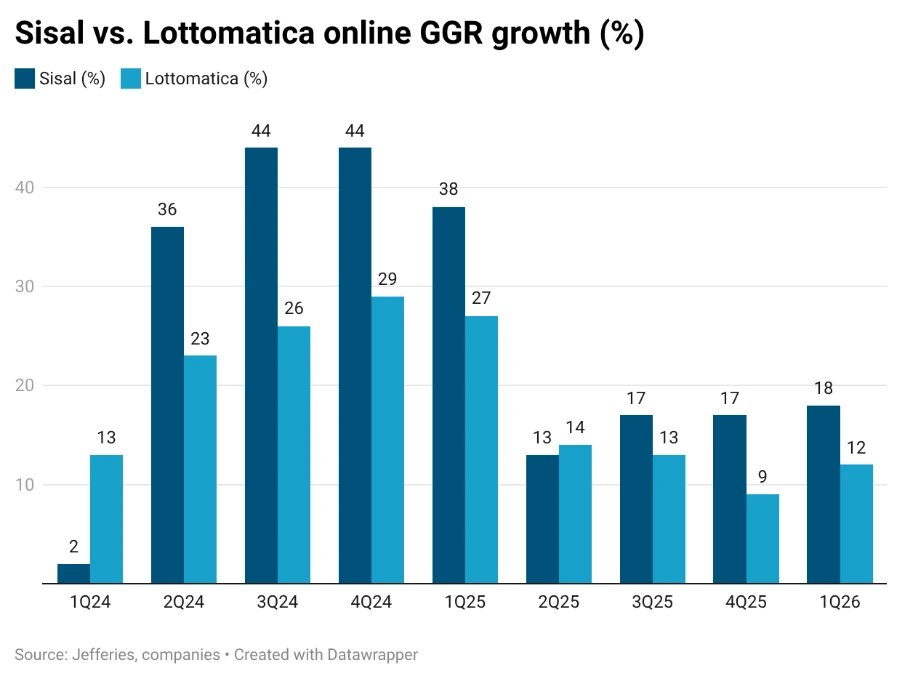
The historical Sisal comparison strengthens that case. Jefferies said Sisal has outgrown Lottomatica’s online business in seven of the past eight quarters under Flutter ownership and has beaten Lottomatica in iGaming growth in each of the past eight.
SNAI also brings something Sisal alone could not: substantially greater retail scale. Jefferies estimates acquiring SNAI lifted Flutter from around 20% to 27% of online GGR, while increasing its retail sports betting share from 12% to 32%. In a market where retail presence provides an important customer-acquisition advantage, that is a powerful combination.
Lottomatica isn’t standing still
Yet any suggestion that Flutter has a clear path to leadership needs tempering by Lottomatica’s own performance.
CEO Guglielmo Angelozzi told analysts that the Italian online market grew 12% in Q2, accelerating to 19% in June, while Lottomatica continued to gain share across sports, iGaming and overall online.
“In a mix of organic growth and M&A, we’ve gone from a marginal operator to the largest operator in the market,” he said.
Online revenue increased 24% in Q2 and 25% on a normalised basis, while online adjusted EBITDA margins reached 58% in H1. Lottomatica therefore enters the fight from a position of considerable strength.
It also has its own migration success story. Planetwin365’s sports share has moved above its pre-migration level, with CFO Laurence Van Lancker saying it had gained 0.2 percentage points, while iGaming has recovered around half its lost ground.
That experience also informs Lottomatica’s attitude towards the escalating competition. The company repeatedly stressed that it will not pursue market share regardless of economics.
“The point is not only acquiring market share, but acquiring quality market share at a sustainable cost,” Angelozzi told analysts. Van Lancker similarly emphasised “profitable growth” and promotional discipline.
That arguably defines the coming battle. Lottomatica is attempting to defend leadership while preserving exceptionally high online profitability; Flutter is applying its global product and technology capabilities to two of Italy’s strongest brands, with SNAI offering the clearest incremental opportunity.
The early Flutter evidence is encouraging, but one month of 30% player growth is not yet proof that SNAI’s long-term market-share decline has been reversed.
If it has, however, the numbers look uncomfortable for Lottomatica. Jefferies’ data suggests Flutter does not need to invent a new Italian success story. It needs to repeat with SNAI what it has already achieved with Sisal.