
CME’s Duffy and Selig exchange fireworks at CFTC committee hearing
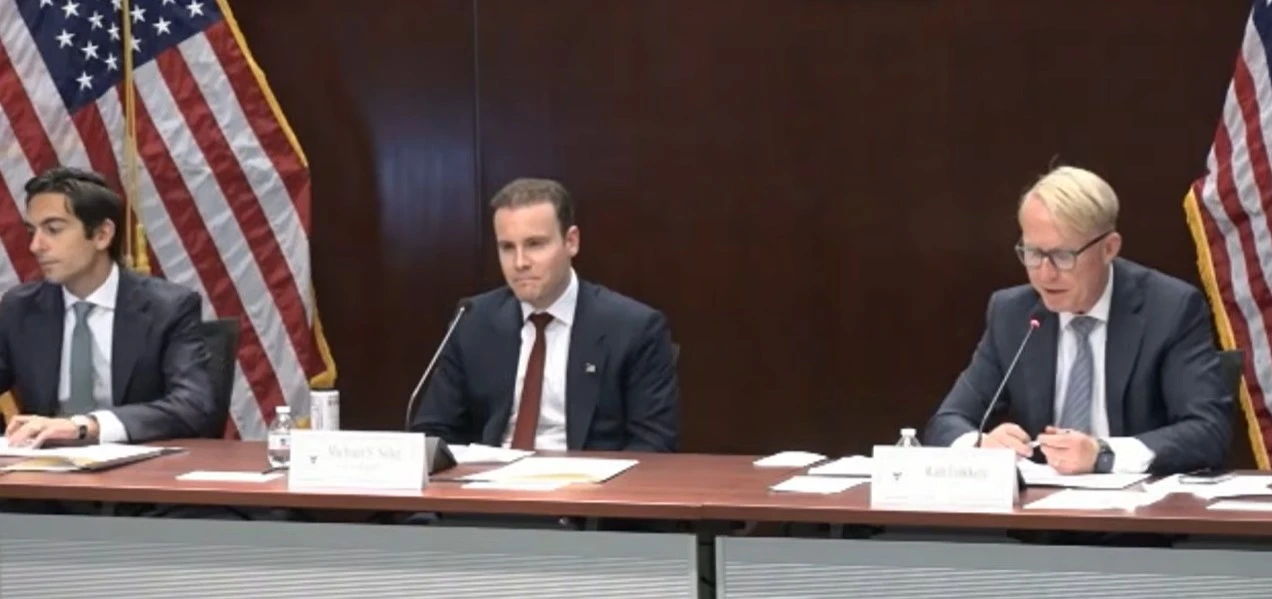
Some of the nation’s most acclaimed executives in the derivatives market waited hours at a prominent conference on Thursday to see fireworks exchanged between clashing factions.
As the US Commodity Futures Trading Commission continues the laborious process of crafting regulations on sports event contracts, the agency hosted an advisory committee’s inaugural conference on Thursday afternoon. A massive roundtable inside the CFTC’s Washington, DC headquarters featured the likes of Robinhood CEO Vlad Tenev and Gemini co-founder Tyler Winklevoss, as well as sports betting executives Jason Robins, Matt King and Christian Genetski.
For several hours, the CFTC’s Innovation Advisory Committee trudged through some fairly dry topics on crypto asset management and agentic finance. But shortly after a panel on prediction markets began, it took mere minutes for tempers to flare. A preamble from CME Group CEO Terrence Duffy on various forms of market manipulation triggered a contentious exchange with CFTC Chairman Michael Selig.
Incensed by a bevy of objectionable contracts that Duffy believes are “susceptible to manipulation”, the veteran executive expressed frustration that the derivatives could tarnish the integrity of the markets. Duffy cited three in particular that he believes are in violation of CFTC Core Principle 3: a contract on the ouster of Venezuela President Nicolas Maduro, a derivative traded by a former teleprompter operator for US President Donald Trump and several sports-related contracts. The principle mandates that Designated Contract Markets (DCMs) only list contracts that are not vulnerable to trading manipulation.
Selig, who was sworn in as the 16th CFTC chairman last December, interjected that the products were “not listed” in the US, but instead offshore. The tense interaction highlighted the final panel of the meeting. Without a subsequent meeting scheduled, critical questions remain on if the meeting will lead to meaningful results in the rulemaking process.
Carnival barkers at a circus?
The aforementioned teleprompter incident received a close dissection on social media, where industry executives were quick to point out that the trade was placed on Kalshi. Gabriel Perez, the longtime teleprompter operator for Trump, is reportedly under investigation for “mention” trades on the president’s remarks. Perez, who allegedly generated more than $100,000 on the contracts, is being probed for trading on insider information regarding Trump’s prepared remarks.
The trades were flagged by Kalshi’s internal surveillance team, which subsequently alerted the CFTC on the potential irregularities. Kalshi co-founder Luana Lopes Lara attended the meeting in place of CEO Tarek Mansour, her former MIT classmate.
Selig, though, apparently misspoke, telling attendees that the trades were placed outside of the US. The CFTC chairman did correctly identify that the Maduro trade in question was made on an offshore platform. Gannon Van Dyke, a US special forces soldier, is facing charges that he allegedly used classified information on a Maduro raid for a series of Polymarket trades.
Beyond the Maduro transaction, Duffy took exception with other self-certified contracts that he believes are ripe for manipulation. Duffy did not identify any sports-related trades by name, but indicated that the industry should not chase participants out of regulated markets by lowering its standards.
“That is horrible for the industry, we are not a bunch of carnival barkers at a circus,” Duffy said. “We are running the most envious markets in the world.”
Selig, meanwhile, underlined several avenues to consider for establishing a prediction markets roadmap. The CFTC has already proposed amendments to Rule 40.11 that gives the agency discretion to determine whether contracts on war, terrorism and assassination are contrary to the public interest. The regulator may also establish expectations for product governance, market design and incentive programmes, he noted.
Sportsbook CEOs remain close to the vest
The CME executive also had a contentious exchange with Lara later in the session. Duffy called into question why the CFTC has allowed Kalshi to offer so-called “compute contracts”, while the CME’s application on the derivatives remains under review. Compute contracts are binary contracts that allow users to trade on the future price of AI graphical processing units such as microchips from Nvidia.
The comments prompted Lara to ask Duffy if the CME ever dealt with a single case on manipulation. In response, Duffy cracked that the CME Group’s regulatory staff is larger than Kalshi’s entire workforce. Without a pause, Lara replied sardonically, “maybe you should learn a bit about efficiency then”.
DraftKings CEO Jason Robins oddly played the role of peacekeeper when he urged participants to avoid “any infighting” that could get in the way of “constructive dialogue”. Neither Robins nor his peers from leading sportsbooks addressed substantive matters such as regulations on market-making or federal preemption. King, who serves as CEO of Fanatics Betting + Gaming, underscored the need to establish a principals-based approach for consumer protections, along with responsible trading. Genetski, the newly installed CEO at FanDuel, briefly stated that the company’s immediate objectives for predictions centre on the need to build consumer trust.
Selig did not indicate if the committee will convene again this year. He also did not address if the CFTC plans to issue final rules on sports-event contracts before the start of the football season. The CFTC chair described prediction markets, AI and the blockchain sector as areas of innovation that he thinks will shape financial markets for the decades ahead.
“We’ve crossed the Rubicon and are standing at a new frontier of finance,” Selig said.

Matt Rybaltowski
Matt is primarily responsible for long-form feature coverage on complex sports betting scandals. He also provides coverage on finance, M&A and other technological developments.