
Why fans at NFL Aussie game won’t trade on Kalshi from their seats in Melbourne
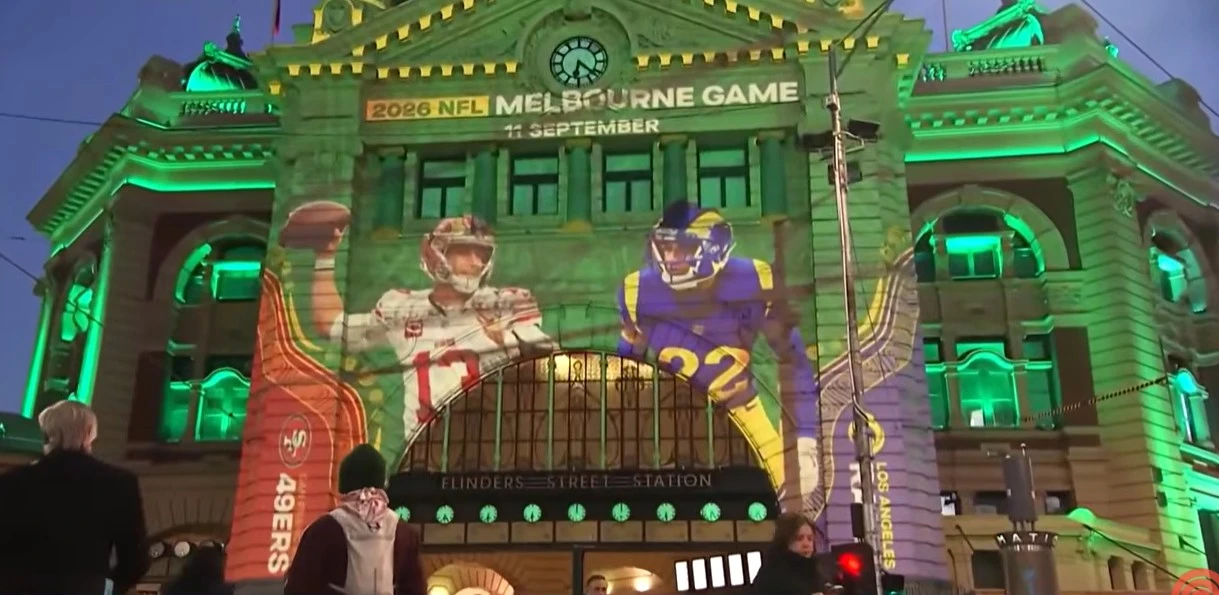
When Australia hosts its first-ever regular season NFL game, an estimated 10,000 US fans are expected to attend the matchup at the Melbourne Cricket Ground following an exhausting trip that features one of the world’s longest flight paths.
The historic showdown between the Los Angeles Rams and the San Francisco 49ers will take place at a venue located 7,971 miles from Levi’s Stadium, home of the last meeting between the NFC West rivals. Both teams are based in California, a fertile ground for prediction markets given a sports betting ban in a state with more than 39 million residents. But the Americans in attendance for Thursday night’s matchup (Friday in Melbourne) will not be able to live-trade from their seats.
That is because trading on prediction markets is illegal down under, according to the Australian Securities and Investment Commission, the nation’s regulator on financial services. Last month, in perhaps the ASIC’s strongest warnings yet against the asset class, the commission reiterated that prediction markets are not licensed as financial markets to operate in Australia. Through the guidance, the regulator urged consumers to exercise caution before partaking in certain investments on offshore platforms which have not obtained licensing nationwide.
The advisory could be music to the ears of NFL Commissioner Roger Goodell, whose league has pushed a federal derivatives regulator in the US to enact more rigorous standards to help protect the integrity of professional sports. Ahead of the matchup, Goodell spoke with CNBC from Melbourne.
“We think there needs to be stronger regulations into the predictive markets,” he said. “We want to see that to protect the integrity of our game — we want to make sure we are protecting the consumers that are on those platforms.”
Restrictions on Kalshi
Despite a rapid ascension throughout the US, Kalshi has been relatively mum on potential international expansion down the road. There is some sentiment that Kalshi will wait to build abroad until after the completion of an initial public offering. At present, Kalshi has sought a valuation of around $44 billion.
Kalshi has imposed strict protocols for customer sign-up, which includes proof of US residency, along with a US tax identification number. The operator also requires traders to complete a robust know-your-customer check before trading on its site.
Per a nine-page member agreement issued by Kalshi in June, users are required to acknowledge that they are prohibited from trading on event contracts if domiciled in roughly three dozen countries. Australia, by way of the ASIC ban, received inclusion on the list. Under the agreement, Kalshi reserves the right to deny users access to its platform in the restricted jurisdictions.
In a statement released in August, ASIC Commissioner Alan Kirkland wrote that users who opt to engage with overseas operators may miss out on “protections” afforded to them on Australian soil. Another regulator, the Australian Communications and Media Authority, banned Polymarket from operating nationwide in 2025. According to the agency, Polymarket violated the Interactive Gaming Act of 2001 by accepting in-play betting on sports events.
Immense pressure on the Rams
As of 3 pm ET, the Rams had odds of 64% on Kalshi to upend the Niners in Melbourne. For a trader who risks $100, a Rams’ win would return $150.15. The Rams, which added Pro Bowl defenders Myles Garrett and Trent McDuffie in the offseason, are considerable favourites to capture Super Bowl LXI in February.
With odds of 17% on Kalshi’s futures market, the Rams are the only NFL team to open the season with double-digit odds. The probability translates to +488 in American odds, a figure that is regarded as comparatively low for a Super Bowl favourite. But history is not on the Rams’ side — all of the last 25 NFL teams to open a season with futures odds of +500 or lower have failed to win the Super Bowl, according to Yahoo Sports.
In May, the NFL sent a letter to the US Commodity Futures Trading Commission with a list of certain event contracts it deemed objectionable. By July, the league doubled down with public comments to the CFTC after the agency issued draft regulations for the contracts. The NFL cited props on player injuries, penalty totals and missed field goals as those that fit the bill. Goodell, however, conceded that the NFL has held discussions regarding prediction markets as public policy evolves.
Two other leagues, Major League Baseball and the National Hockey League, have each signed a Memorandum of Understanding with the CFTC that allows participating teams to partner with the operators.
“We don’t think we have to be first in this, we feel like we’re going to be right,” Goodell said. “The best thing to do is be patient and make sure you keep the integrity of the game No. 1.”

Matt Rybaltowski
Matt is primarily responsible for long-form feature coverage on complex sports betting scandals. He also provides coverage on finance, M&A and other technological developments.