
Prediction market roundup: Sides clash at heated legislative hearing in Texas
The old adage, “Everything is Bigger in Texas,” does not refer solely to the state’s massive geographic size, which, at 268,820 square miles, ranks as the second-largest state in the US behind Alaska.
Instead, the phrase embodies the ethos of the Lone Star State, where Texans demonstrate a sense of pride and identity that exemplifies the state’s outsized persona. As event contracts proliferate, the adage could be applied to prediction markets, where volume ranks among the highest in the nation. Last Sunday, for instance, trading activity for an NFL matchup between the Dallas Cowboys and the New York Giants topped $208 million across US markets, figures from Aldrin Research show. At Kalshi, volume for the NFC East showdown on Sunday Night Football eclipsed that of any NFL regular-season game last year.
The volume is not only seen across NFL markets, but also on those in college football, which is practically a religion in Texas. When Ohio State faced Texas in a Top 5 matchup on 12 September, volume surpassed 50.7 million contracts traded, according to Odds Shopper, a prediction market tracking site. The robust activity set the stage for an intense legislative hearing three days later in the Texas Senate.
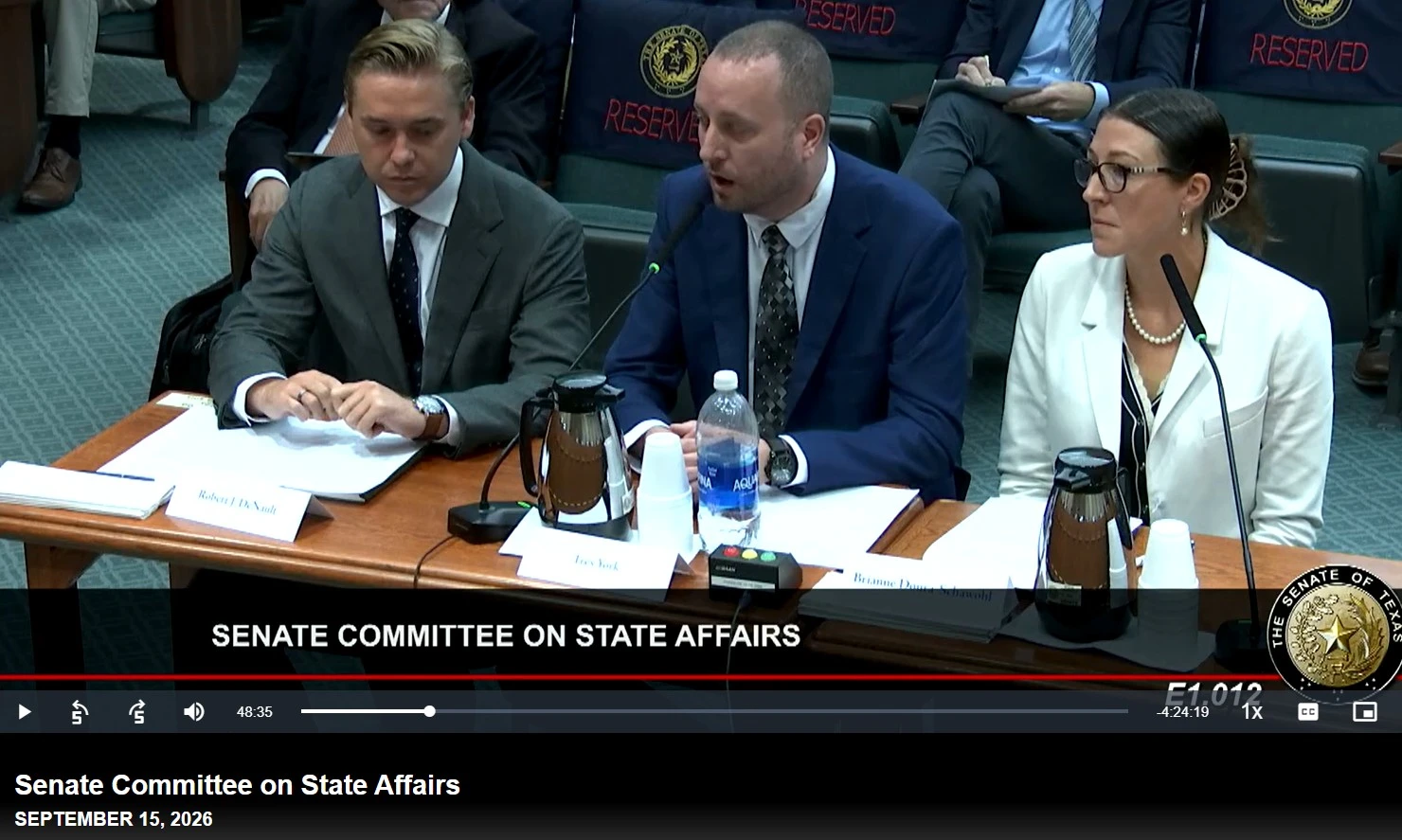
The 62-minute hearing featuring Kalshi and a prominent lobbyist from the American Gaming Association provided a blueprint for the state’s evaluation of prediction markets next year. Before the calendar turns to 2027, though, stakeholders will monitor races for governor, attorney general and the US Senate on election night. The results in all three Texas races will likely have a major impact on the future of prediction markets inside the state.
A pause until after the midterms
Convened by Texas state Senator Bryan Hughes, the hearing in the Senate Committee on State Affairs examined the relationship between federally regulated derivatives markets and state-prohibited gambling. Research from Eilers & Krejcik Gaming in April found that 43% of activity from sports-event contracts came from two states, Texas and California. A separate breakout of Texas activity alone is not publicly available.
At Tuesday’s hearing, AGA Vice President Tres York testified before the committee alongside Robert DeNault, head of enforcement and legal counsel at Kalshi. The AGA, one of the nation’s most strident critics of prediction markets, argued that an event contract on the Cowboys to beat the Giants does not differ fundamentally from the same wager placed at a sportsbook.
As with California, sports wagering is illegal in Texas. Greg Abbott, a three-term governor, is up for re-election in November, along with Dan Patrick, his lieutenant governor. Patrick, who vehemently opposes sports betting, also serves as president of the Texas Senate in his current role. Several attempts to legalise sports wagering since the 2018 PASPA decision have been foiled under Patrick’s leadership.
Texas Attorney General Ken Paxton is in the midst of a heated US Senate campaign against Democratic challenger James Talarico. Paxton will be succeeded as Texas AG by state Senator Mayes Middleton, a Republican from Galveston, or his Democratic opponent Nathan Johnson, a state Senator from Dallas.
State Senator Bob Hall represents Senate District 2 in Texas, a district that contains parts of Dallas. Hall, 84, did not see a distinction between event contracts and sports wagers, noting that the former is just dressed up in a different manner.
“They’re different costumes on gambling,” he said. “Some have high heels and a tiara and others have on miniskirts or a bikini.”
Don’t mess with Texas
Asked by Hall on how Texas should proceed moving forward, York advised that the state should seek an order that would require prediction markets to geofence their platforms from operating statewide. York also prefers the pursuit of litigation against prediction markets in state court, rather than the federal circuit, where state attorney generals have been less successful.
“Prediction markets think they can mess with Texas,” York said. “I hope you prove them wrong.”
In response, DeNault noted that prediction markets regulated on the federal level by the CFTC offer a “safer alternative” than many offshore operators that lack the requisite consumer protections.
“You can go the combative route and ban something that’s federally regulated,” he said. “But what you’ll end up with is a bunch of customers in Texas just going offshore.”
The committee also heard from Brianne Doura-Schawohl, a nationally recognised problem gambling expert. One study cited by Doura-Schawohl found that 52% of Gen Z respondents include sports betting and prediction markets as part of their long-term financial plan.
She also criticised a Kalshi competitor for offering a function that allows minors over 17 to link an investment account with the ability to buy and sell event contracts. A former legislative director for the National Council on Problem Gambling, Doura-Schawohl described the opportunity as “very dangerous” for teenagers susceptible to harm.
Tribal prediction market partnership in Louisiana
Outside of Texas, Kalshi made history on Friday when it became the first prediction market to sign a partnership with a federally recognised sovereign nation.
One day before a primetime showdown between the University of Mississippi and Louisiana State University, the Tunica-Biloxi Tribe of Louisiana announced the launch of a tribal prediction market app. The new app, powered by Kalshi, will be launched through SaltTrade Derivatives, a newly established subdivision of a tribal-owned enterprise.
Through the collaboration, the tribe will draw upon Kalshi’s established infrastructure and market expertise to develop a distinct tribal-owned trading application, said Tunica-Biloxi Chairman Marshall Pierite in a statement.
“This partnership represents exactly the type of opportunity Indian Country should be pursuing, where Tribes are owners, innovators and leaders, not just participants,” he said. “For generations, the Tunica-Biloxi people have adapted, traded and built relationships that allowed our Nation to prosper. This initiative carries that tradition into the modern economy.”
Lane Kiffin will face Ole Miss, his former team, for the first time since he was named LSU head coach last November. For Kiffin’s return to Oxford, the Tigers are 59% favourites at Kalshi.
The announcement came on the same week that Indian Gaming Association leaders met with CFTC Chair Michael Selig. The meetings centred on prediction market-related discussions that IGA Chair David Bean deemed mostly unproductive. On Wednesday, the US Court of Appeals for the Ninth Circuit reversed a lower court’s decision in Blue Lake Rancheria v. Kalshi.
Per the ruling, the Ninth Circuit determined that Kalshi’s sports event contracts amount to unauthorised gaming under the Indian Gaming Regulatory Act (IGRA) when accessed on tribal land.
“Today’s decision reinforces a fundamental principle: when sports wagering occurs on Indian lands, federal Indian gaming law matters,” said Bean on Wednesday.

Matt Rybaltowski
Matt is primarily responsible for long-form feature coverage on complex sports betting scandals. He also provides coverage on finance, M&A and other technological developments.