
Player props and performance markets: how bettors engaged with the World Cup

In the two months since Spain captain Rodri lifted the FIFA World Cup trophy, sportsbooks have been piecing together their key findings from a sporting spectacle that dominated the agenda from the first game to the final.
With new domestic seasons now well underway across European football, attention has swiftly moved on.
However, for sports betting operators, the lessons learned over the 39-day tournament will inform and influence strategies for months and years to come.
Understanding the activity spike
Although it is impossible to verify pre-tournament claims that an average of $500m would be wagered globally on every game, it is no secret that the 48-team, 104-game extravaganza was the biggest sports betting event in history.
Data released by WSF Odds – a sports betting technology provider specialising in pre-match and live football odds across player, team and match props – offers a compelling snapshot.
Over the eight months before the World Cup, from October 2025 to May 2026, WSF Odds generated €389m in turnover and €61.4m in gross gaming revenue (GGR) across its products. In June and July, when the World Cup dominated the agenda, turnover rocketed to €163.8m and GGR hit €27.1m.
Average monthly turnover over those two months was around 68% higher than in the previous eight months, while average monthly GGR was around 76% higher. In addition, the overall margin improved from 15.8% to 16.5%. However, the data-driven implications run much deeper than the headline figures.
Traditional markets
WSF Odds, which operates across more than 30 countries spanning Europe, the Americas, Africa, the Middle East, Asia and Oceania, provides a wide range of markets covering 99 football competitions worldwide.
Aggregated data from a broad group of operators – including clients such as Betclic, Betsson and Tipsport – as well as distribution partners like Altenar, gives WSF Odds a broad dataset to explore how player, team, match and goalscorer markets performed during the World Cup.
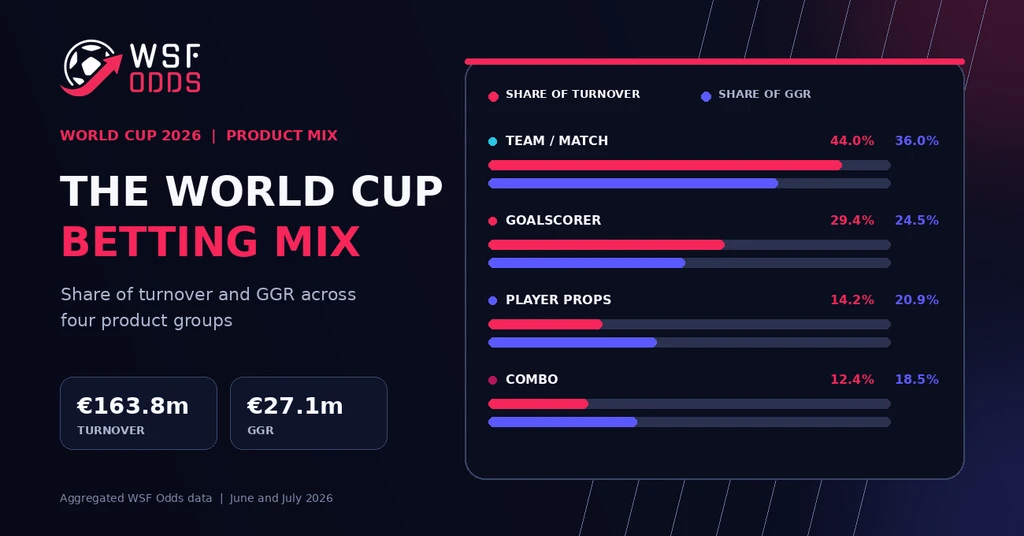
As a starting point, punters did not move away from traditional markets during the tournament, with goalscorer markets, for example, remaining very strong. While goalscorer markets represented 28.8% of WSF Odds’ turnover before the tournament, the proportion increased to 29.4% in June and July.
“The important point for us is that demand for goalscorer betting remained strong while the category itself became broader,” says WSF Odds product owner Filippo Celleno.
“We did not see bettors abandoning goalscorer markets. We saw the football offer becoming broader around individual players, with more ways to bet on scoring and performance.”
“Our goalscorer offer now includes 42 markets, ranging from the standard goalscorer bet to newer formats such as Supersub and method-of-goal. This gives operators more ways to build around the same basic bettor interest: who will score, and how, while adding further dimensions such as when, from where and how important the goal will be. Alongside the standard goalscorer offer, newer formats such as Supersub and method-of-goal markets give operators more ways to build around the same basic bettor interest: who will score, and how.”
Player props popularity grows
The rising popularity of player props was also evident, continuing the broader growth of such wagers across major sporting events such as UEFA Euro 2024.
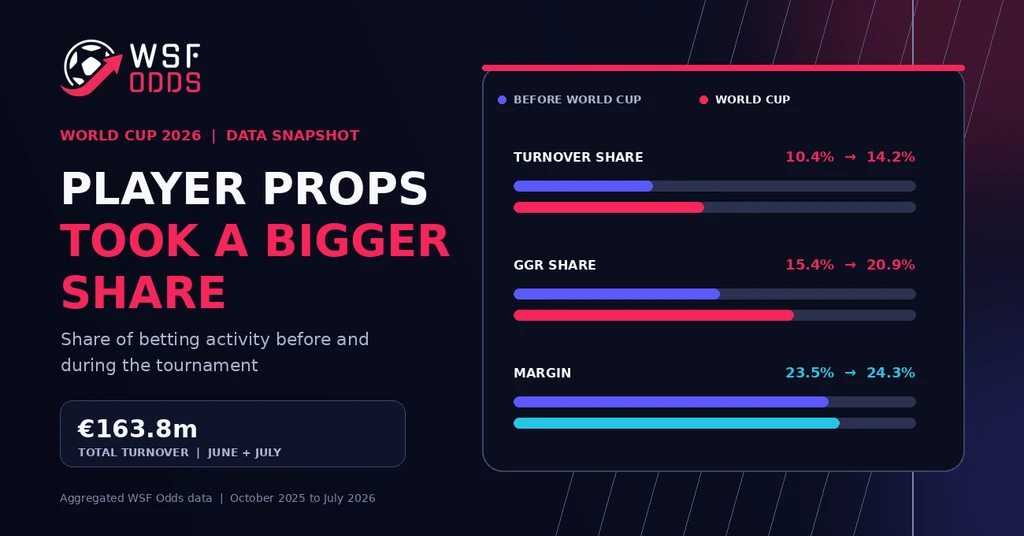
Before the World Cup, player props represented 10.4% of WSF Odds’ turnover and 15.4% of GGR. In June and July, those figures increased to 14.2% of turnover and 20.9% of GGR. Margin also remained strong, at 24.3% during the World Cup in comparison with 23.5% before the big kick-off.
“We did not see bettors abandoning goalscorer markets,” Celleno explains. “We saw the football offer becoming broader around individual players, with more ways to bet on scoring and performance.”
Meanwhile, team and match markets accounted for the largest share of WSF Odds’ activity, generating about 44% of turnover and 36% of GGR in June and July.
Team and match shots generated around €30.8m in June and July, while team and match shots on goal generated around €22.6m. On the player side, shots on goal was the largest performance market, with €12.2m in turnover and €2.2m in GGR, while WSF Odds also saw meaningful activity in player assists, player shots and player cards.
Performance markets
In a knockout tournament – especially one full of surprises, from Germany’s defeat by Paraguay to Norway’s shock win over Brazil – the popularity of performance markets is understandable, according to WSF Odds sales director Sam Hill.
“Knockout football is difficult to predict by definition,” Hill says. “Two strong teams can be very evenly matched, and one goal, one red card or one moment in extra time can decide everything.
“For us, the World Cup showed the value of having several strong football categories working alongside each other.”
“But that does not mean the bettor has no opinion about the match. They may expect one team to produce more shots. They may think a striker will get several attempts on target. They may expect a defender to commit fouls because of the player he is facing.
“Performance markets give bettors another way into the match when choosing the final winner feels less obvious. They can follow what is happening on the pitch and bet around individual actions rather than relying only on the final score. For operators, that creates more opportunities to keep a customer engaged throughout the match.”
Combo markets
The World Cup demonstrated the growing appeal of betting on a range of performance-related metrics – and not just goals.
Celleno adds: “For us, the World Cup showed the value of having several strong football categories working alongside each other. Goalscorer remains central, while player props, team and match markets and newer products such as Combo give operators more ways to capture different betting behaviours within the same match.”
For operators without an extensive live Bet Builder covering a full range of props, pre-built Combo markets provide another route to multi-selection betting. They also suit bettors who want a quick, ready-made selection.
The World Cup was the first major test for Combo markets, which launched shortly before the tournament. In June and July, Combo markets generated around €20.3m in turnover and just over €5m in GGR, representing about 12% of total turnover and 19% of GGR during the period.
“Usage during its first major competition was encouraging,” Celleno says. “It showed that customers were comfortable going beyond a single market and combining several views of what might happen in the same match.”
Casual bettors
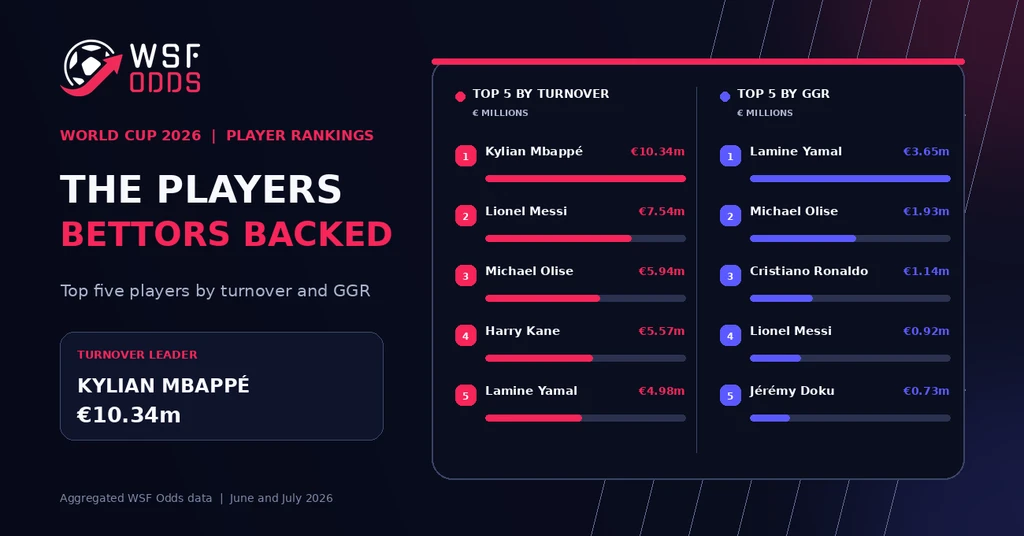
The tournament’s star names also helped to underpin the popularity of player props and performance markets during the World Cup – while also engaging casual fans and bettors in the tournament.
According to one study by Optimove, deposits from first-time bettors surged during the competition’s group stage by 171% in the United States, 200% in the European Union, and 300% in Latin America. This created an opportunity for sportsbooks to retain new bettors into the latter months of 2026 and beyond, while introducing them to a broader range of markets.
“For several weeks, casual viewers are exposed to the same players again and again,” Hill says. “They see Haaland. They see Bellingham. They see Salah and other players discussed across match coverage, social media, interviews and statistics.
“By the end of the tournament, some of those viewers know much more than just the player’s name. They know who shoots a lot, who creates chances, who gets involved in duels or who is likely to pick up a card.
“That can give them a reason to keep following the player when club football starts again. Someone who became interested in Haaland may pay more attention to Manchester City. Someone following Bellingham may now have a reason to watch Real Madrid.
“For sportsbooks, that creates an opportunity to continue the conversation after the World Cup.”
Turning familiarity into retention
Sportsbooks must provide such bettors with relevant and easy-to-find markets if they are to convert that familiarity into retention.
Hill points out that casual bettors should not need to search through a long sportsbook menu to find player-specific markets.
“The same applies to existing bettors,” he says. “Someone may already be planning to bet on the match winner or total goals. If they now know more about the players involved, they have another reason to add a player selection to the bet slip.”
The broader point is that the World Cup proved that bettors are ready to wager on more than just results. “The World Cup makes that especially visible because casual fans and regular bettors are watching the same tournament at the same time,” Hill says.
However, as Celleno adds, the question is whether this betting behaviour persists when memories of the World Cup fade.
“We want to compare the first part of the domestic season with both the World Cup period and the months before it,” Celleno concludes. “In particular, we will be watching whether player props keep a larger share of turnover and GGR, or whether the mix returns to its previous level.
“That will tell us more about whether the World Cup created a short tournament effect or whether some bettors carried these habits into club football.”