
Nevada regulators raise ‘significant concerns’ with Bally’s Las Vegas project
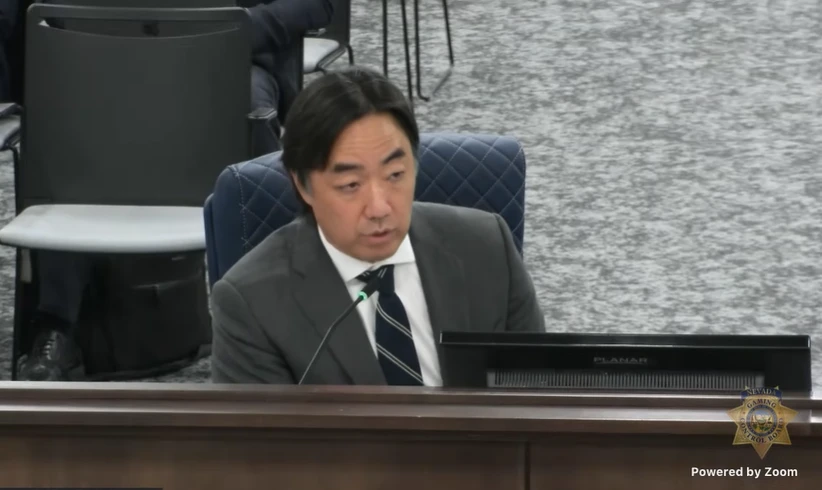
Bally’s Corp Chairman Soo Kim did not appear before the Nevada Gaming Control Board and Gaming Commission Thursday to discuss his company’s ongoing development on the Las Vegas Strip, but that was what captured the most attention during the appearance before state regulators.
The real purpose of the expedited hearings was the approval of Bally’s acquisition of UK operator evoke through its Intralot intermediaries. Certain sign-offs were necessary from the board and commission to close the transaction, which were granted unanimously with little discussion.
Things got interesting, however, when NGCB Chair Mike Dreitzer zeroed in on Bally’s Las Vegas project, which has been a subject of growing controversy and speculation. Bally’s has pledged to build a $1.19 billion mixed-use development adjacent to the soon-to-be Las Vegas A’s MLB stadium, but the site has seen little progress since Bally’s imploded the former Tropicana in October 2024.
Dreitzer said he has “significant concerns” about the Strip project and where it falls among Bally’s priorities. Given the number of projects the operator is juggling, including the evoke acquisition for which the hearing was given, Dreitzer said it feels as though Las Vegas is “the bottom of the barrel” for Bally’s.
In response, Kim assured the board that the development is “very important” to the company. Bally’s cannot be the global operator it aspires to be, he said, if it doesn’t “have a presence, and a strong one,” in Las Vegas.
“We don’t intend to let the state or the board or the county or the city down,” Kim said.
Kim: Las Vegas obligations ‘can and will be met’
The A’s are on track to debut in April 2028, but there is trepidation among stakeholders about whether Bally’s can fund and build its share of the project in time. Earlier this month, the Las Vegas Stadium Authority convened a meeting to discuss potential solutions between the A’s, Bally’s and GLPI, which owns the real estate assets.
GLPI has offered to extend financing that is conditioned on matters settled between Bally’s and the team, while the A’s maintain that “a contingency plan” is necessary, per the Las Vegas Review-Journal.
Kim said Thursday that the project “has a certain level of complexity being a three-party deal”. Bally’s main obligations to the site are a parking structure, utility connections and a connection between the corners of the Strip and the entrance to the ballpark. He asserted that “each of those obligations can and will be met” by Opening Day of the 2028 MLB season.
Prior to the discussion about Las Vegas, Kim acknowledged that Bally’s has many financial obligations, some of which are binding to the company and some are not. Kim said that Bally’s parent company would have to evaluate whether to inject more funding into evoke if the business were to decline. This blasé approach did not appear to sit well with Dreitzer, who referenced it later when talking about the Strip.
“From my perspective, you’re starting all these projects and it’s your responsibility to finish all these projects in the best way you can,” Dreitzer said. “It isn’t a matter of ‘Hey, let’s see what happens’, especially in the state of Nevada, that’s not acceptable…’We’ll see what happens’ is not good enough. It has to happen.”
Financing and stock woes
In addition to the Las Vegas project, Bally’s is in the final stages of its $1.8 billion Chicago resort and the beginning stages of its $4 billion resort in New York City.
The Chicago project has seen a number of hiccups, the latest being a dispute with the city over its legalisation of video gaming terminals. Concerns about VGT cannibalisation have led Bally’s to slow the construction of certain non-gaming elements while only committing to opening the casino, 100 hotel rooms and some of the food and beverage outlets early next year. According to Truist analyst Barry Jonas, the operator is projecting to finish the casino in February with a soft launch on 1 May.
In order to finish Chicago and make progress in Las Vegas and New York, Bally’s has relied on several loans and funding agreements. Two separate financing packages of $560 million each — one for the New York project and another for “general corporate purposes and further development” in Chicago — have been announced in the last two months.
Bally’s ended the third quarter with $497 million in cash against long-term debt of $4.8 billion. Shares fell 7% in trading Thursday to $9.90 and are now down 40% so far this year.