
How iGaming operators can move AI from pilot to practice
In the AI gold rush of 2026, some businesses in the iGaming space have been scrambling to keep up.
At the start of the year, industry experts were cautious about AI, despite acknowledging its inevitable impact, due to concerns around privacy, job displacement, hallucinations and loss of control.
As 2026 draws to a close, such concerns have not vanished, but AI adoption is on an upward trajectory
The benefits of AI for iGaming operators, from harnessing data to personalising experiences, have been increasingly well articulated this year across earnings calls, conferences and white papers. More than half of iGaming stakeholders identify AI growth as the leading macrotrend for 2027.
The future impact of AI on the industry, though, is difficult to quantify.
One study published in April 2026 by the UNLV International Gaming Institute in collaboration with KPMG found that only one in five gaming businesses had seen a meaningful return on their AI investment so far. Less than a third expected an ROI on their AI expenditure within 12 months.
The right foundations
As a first step, Mouhcine Jalili, vice-president of growth at Software Mind, believes iGaming businesses will struggle to maximise the potential of AI unless they address the fundamental issue of data fragmentation.
“Operators may already have the systems, infrastructure and data – but that data might be fragmented,” says Jalili, who adds that after years of expansion and diversification, many gaming companies have entered a phase of consolidation.
“Operators may have grown by acquiring more brands, and they’re trying to migrate to one platform. The hardest bit is making sure the platform and the data aren’t fragmented.”
Data siloes are barriers to real AI-driven growth, Jalili explains, but even operators with a single platform and well-organised data can struggle to move beyond experimentation.
“What they lack is a fast route from concept to implementation,” he says.
Jalili’s approach is to start with a specific operational problem and adapt a reusable AI framework to the operator’s existing data, systems and workflows. The operator can then build on that foundation as its needs change.
Accelerators
Software Mind applies this approach through its AI Accelerators.
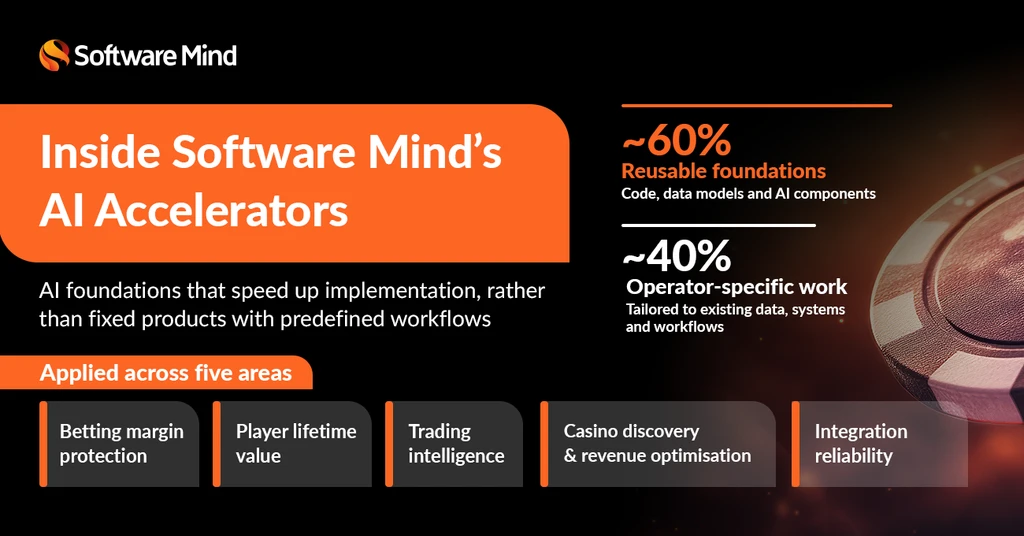
Rather than being off-the-shelf products, AI Accelerators are reusable foundations built from previous implementations delivered across the industry. They combine proven architecture patterns, reusable code, AI components, integration frameworks and delivery experience that can be adapted to each operator’s environment. Operators can then build on top of these foundations according to their own strategy, priorities and requirements.
“The Accelerator provides proven foundations, but every operator still determines how the solution should work”
Jalili puts the split at roughly 60% reusable foundations and 40% operator-specific work, although it varies depending on how closely a project resembles work Software Mind has already done.
Software Mind has identified five areas for its AI Accelerators, covering betting margin protection, player lifetime value, trading intelligence, casino discovery and revenue optimisation, and integration reliability.
“Operators don’t need suppliers like us coming in and telling them what their problem is. They know it better than we ever will,” Jalili explains. “But how that sits within their technology, and how they’ve grown over the last 15, 20 or 25 years, is quite different.
“We have built these foundations by delivering AI solutions for operators and then codifying what works into reusable building blocks. That means we’re not starting every project from a blank sheet of paper.
“The Accelerator provides proven foundations, but every operator still determines how the solution should work, what data it should use and how it integrates into their business. They can then continue extending and evolving it as their requirements change.”
However, as Jalili points out, a common challenge still requires a bespoke solution.
“What I see as the biggest area for AI growth in iGaming is building on existing systems,” Jalili says. “Whether you’re looking at leaking profits, customer service, fraud or payments issues, these are frameworks that can be integrated into your system so you can build on top of them – and ideally you get a faster outcome with lower risk.”
Operator input
Such a process requires a proactive and collaborative client – a different experience for some operators that are accustomed to hands-off supplier integrations.
As Jalili points out, though, the greater the input from the client at the outset, the more effective and adaptable the AI framework will be in the future. Moreover, better foundations will deliver better data – helping operators to evaluate the impact of the solution.
“Sometimes clients do underestimate the process, and sometimes we underestimate it as well,” Jalili says. “We try to do as much due diligence as possible and get very detailed requirements from them about what they need the solution to do.
“We give them feedback loops and approvals as we go through the phases. They can be involved throughout the process, and we give them a choice about how much they want to change their requirements as we go along.
“Keeping those feedback loops open helps us understand what they need, and it gives them confidence that we’ll deliver what we say we’ll deliver.”
Changing the conversation
Jalili also believes that operator ownership changes the commercial conversation surrounding AI integration.
Once the scope is agreed, Software Mind quotes a fixed price for the build. The operator owns the resulting solution, which is tailored to its requirements.
“Commercially, we take the risk, as we try to estimate how long it’s going to take us to develop the customised AI Accelerator and cost it at a fixed price,” he says. “We could get it wrong, and it could cost us a lot more in development hours.
“But it’s a risk worth taking because we see the market changing. That was one thing operators were usually scared of. They’d go into a project and they wouldn’t know how much it would cost them.”
Where an existing accelerator fits the brief, Jalili says development typically takes three to six months, depending on the operator’s requirements.
Owning the strategy
Jalili sees larger operators taking a more coordinated approach to AI. Some are appointing leaders to set a strategy across the business, where individual departments previously procured tools to solve specific problems.
“That’s changing rapidly now,” Jalili explains. “There has been a lot of hiring of AI directors and heads of AI at the biggest operators, because they need someone to own the strategy around how they’re going to use AI.”
At Software Mind, Jalili says AI has helped development teams take on more projects. The company is hiring more people as its workload grows, with an emphasis on more senior staff.
“We’re using AI to develop software a lot quicker than we used to a few years ago,” Jalili says. “If anything, we’ve increased the number of people we’re hiring because we’re getting a lot more projects. The profile we’re going for is more senior because you need people who know what they need from the AI tools we build internally.”
Jalili says the questions clients ask are changing too.
“It used to be, ‘Can you build a solution?’ Now it’s, ‘Can you build a solution using AI?’” For operators with a strategy already in place, he says there is a further question: “Can you fit it into my AI strategy going forward?”
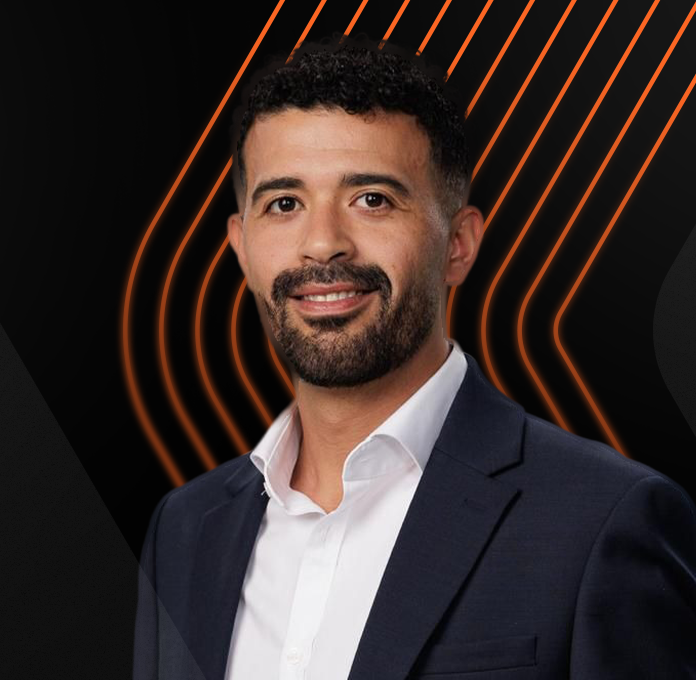
Mouhcine Jalili, vice-president of growth, Software Mind