
With Chicago construction in limbo, what’s next for Bally’s Las Vegas?
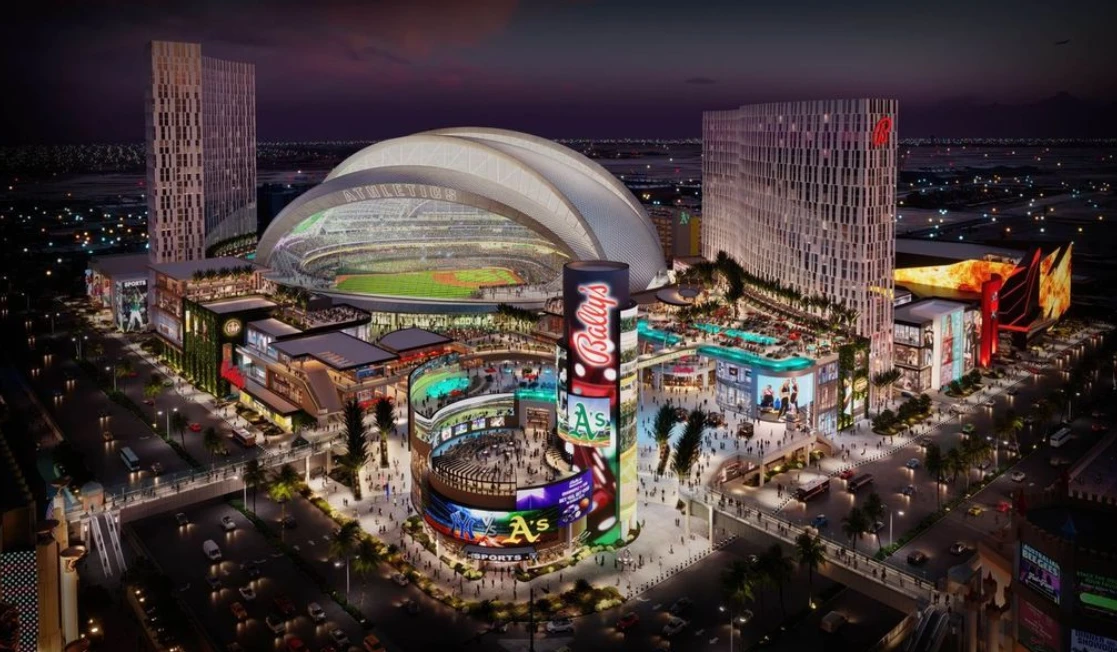
Earlier this week, Bally’s Corp paused construction of the non-gaming elements of its $1.7 billion Chicago casino, which puts immense bargaining pressure on the city after its latest budget lifted a ban on video gambling terminals. But across the country in Las Vegas, Bally’s looks to be the one feeling the heat.
In April 2021, Bally’s purchased the operations of the former Tropicana Las Vegas for $148 million, with the transaction closing in September 2022. Bally’s and landlord Gaming and Leisure Properties (GLPI) subsequently agreed to demolish the property in 2024 to help make way for the Athletics’ MLB stadium project on the site, in exchange for the right to develop a new resort on the remaining acreage.
For nearly a year after demolition, the operator gave few indications about its plans for the site. During that time, Bally’s was pursuing several other developments, including a New York City casino project and a buyout of Australian operator Star Entertainment.
Wheels started turning last September, when Bally’s announced plans for a mixed-use complex with 3,000 hotel rooms across two towers, a 2,500-seat entertainment venue and “more than 500,000 square feet of retail, dining and entertainment offerings”. The lone rendering for the project shows it essentially circling the A’s stadium. Subsequent filings to Clark County in December called for a four-phase buildout with a December 2030 completion date and a cost of $1.19 billion.
Now, as the A’s stadium progresses on schedule toward a spring 2028 debut for that year’s MLB season, there are questions as to what Bally’s portion of the site will look like, and whether the operator can afford to finish it.
LVCVA ultimatum passed
Since the start of the year, Bally’s has emphasised that the construction priorities for the project are geared toward the retail-entertainment district (RED) aspects rather than the casino and hotel. Chairman Soo Kim said at the ICE Barcelona conference in January that his company is “actually more focused on developing an RED”, even “before we build our integrated resort and casino”.
This sentiment was reiterated by CFO Mira Mircheva and attorney Dan Reaser in June. Reaser told the Nevada Gaming Commission during Mircheva’s licensing hearing that the 2028 deadline pertains to the stadium, not Bally’s.
“To make the record clear, the April deadline of 2028 is for the stadium to open and for the baseball season to proceed,” Reaser told commissioners. “The April 2028 timeline is for the retail district, parking garage, utilities and plaza, but not the towers that come at a later date.”
The prospect of the A’s glitzy new stadium debuting with a construction site surrounding it is not sitting well with everyone in Las Vegas. According to a June report from The Athletic, the team is reportedly preparing contingency plans to build its own infrastructure for the site if Bally’s continues to lag. Those additional developments could cost the team $100 million, the report said.
Steve Hill, CEO of the Las Vegas Convention and Visitors Authority, told The Athletic that Bally’s “[doesn’t] have the financing” for the project, and said he asked the company “pretty pointedly” to present a financing plan by August.
When asked about that ultimatum this week, Bally’s declined to comment, and the LVCVA did not respond to a request for comment.
Financing from GLPI
In its 10-Q filing to the SEC from the first quarter, Bally’s reported total cash and equivalents of $559.3 million, against long-term net debt of $4.3 billion. The company has yet to report its second-quarter results, and filed a Form 12b-25 on Tuesday, which indicates the results will be posted late. That marks two consecutive quarters with late filings. Bally’s shares gained 5% in trading on Wednesday to $13.70 but are down about 18% so far this year.
Aside from Bally’s itself, the other stakeholder in the Las Vegas project is GLPI. The gaming-focused REIT has invested billions of dollars into Bally’s projects around the country, including Chicago. Bally’s leased the Tropicana site from GLPI beginning in 2022, and the terms were modified in 2024 after the casino’s demolition. The lease term is 50 years with renewal options to 99 years – in Bally’s Q1 filing, the company said that “the renewal options are not considered reasonably certain to be exercised” at this time.
GLPI has pledged up to $125 million for shared developments deemed to be mutually beneficial on the Las Vegas site. When asked for an update during the REIT’s first-quarter earnings call on 31 July, COO Brandon Moore told analysts that Bally’s is “coming close, I think, to a more concrete plan for some of the critical infrastructure that needs to support the stadium”. This includes things like “access ways” and “utility conduits”, he said.
“There may be an opportunity for us to invest more in that property and some of that key critical infrastructure,” Moore said. “We’ll take a look at that when that time comes. I don’t think we’re prepared at the present time to commit to anything over the $125 million, and we’ll continue to work with Bally’s and see if that makes sense.”

Jess Marquez
Jess has covered the global gaming industry since 2022. A native of Reno, Nevada, he’d like to note that it’s Ne-va-da, not Ne-VAH-da.