
The hunt is back as Yggdrasil unleashes Raptor 3 DoubleMax
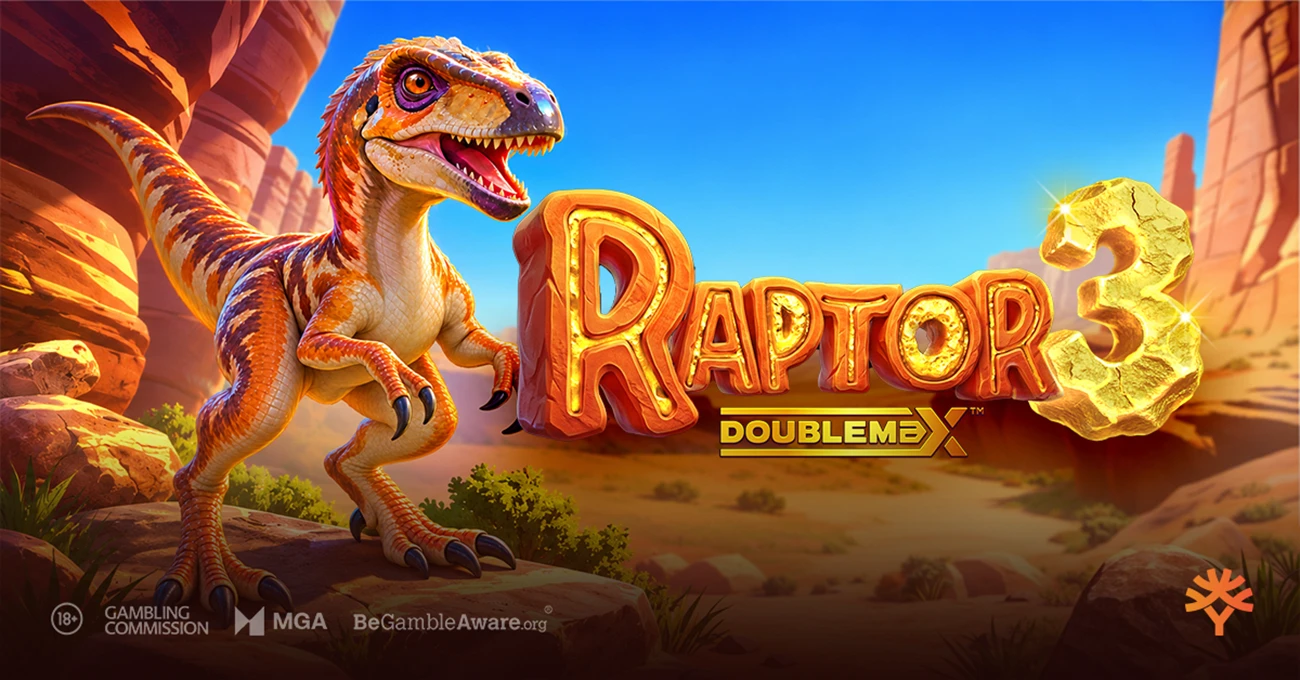
Yggdrasil, the iGaming supplier with 13 years in the industry, has released Raptor 3 DoubleMax, the third title in its prehistoric slot series. Refined with input from players and partners, the sequel brings back the signature DoubleMax multiplier ladder and gives the raptors a bigger role in the action.
This time, the pack has left the jungle for a desert canyon where there’s little room to hide. The base game plays out on a 5×3 grid with 243 ways to win from left to right. Every win triggers an Avalanche. The winning symbols disappear; a Wild takes one of the empty positions at random and new symbols drop into the remaining spaces.
Each consecutive win moves the multiplier one step up the DoubleMax ladder, doubling its value for the next Avalanche. There’s no cap on how high the multiplier can climb, but, when the cascade ends, the multiplier resets to 1x.
The reels are only part of the action. Keep an eye on the bushes outside the grid, where a raptor can appear with a strike of its claws or a roar. Its roar increases the current multiplier by one, even without a win. For example, a 4x multiplier becomes 5x, and the next two levels will be 10x and 20x.
Landing three, four or five dinosaur eggs triggers Free Spins, with five eggs awarding nine spins. During the bonus, the grid can expand to 5×5 or 5×7, taking the number of ways to win from 243 to as many as 16,807. The eggs can land again during Free Spins, triggering the Last Bite feature and adding more spins to the round.
Michał Szafran, junior game producer at Yggdrasil, commented: “Following a success like Raptor 2 meant the stakes were high from day one, Raptor 2 was our first release on Game in a Box, and Raptor 3 showed how much the platform has changed since then and the brilliant things it can do now.
“The scope was massive, because everyone on the team brought ideas for what we could add to make the game even better, and having a team of real professionals all working towards the same goal made that possible. In the end my approach was simple: show what the team can do and build a game that beats its predecessors.”