
Saratoga Conference: NBC’s Kornacki addresses Triple Crown reforms amid major changes
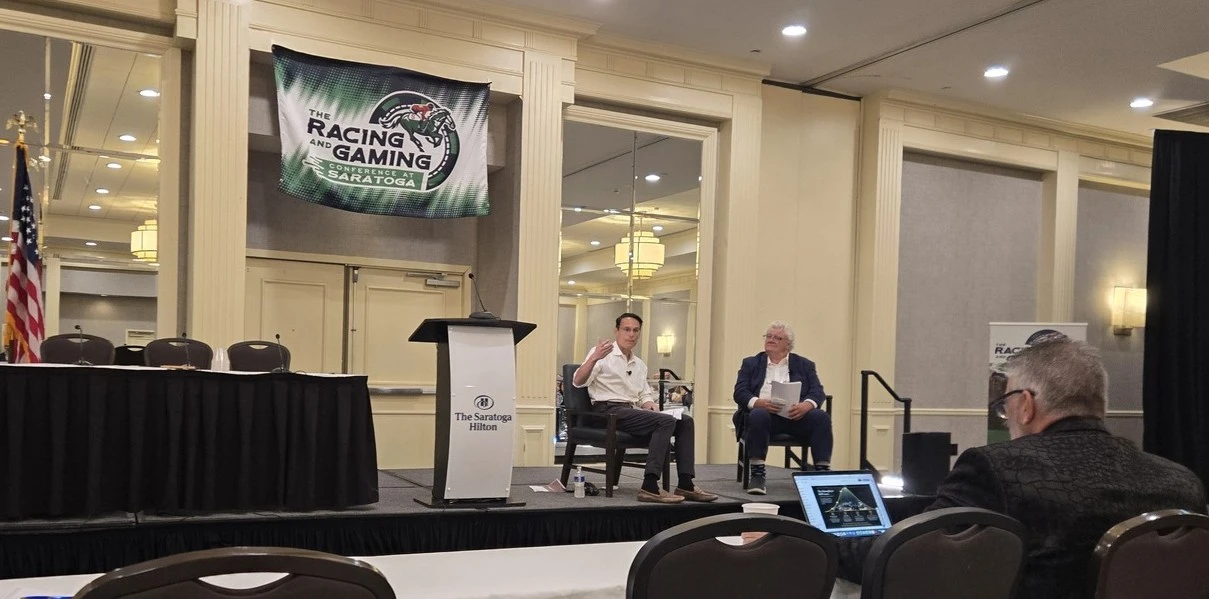
Steve Kornacki laboured through the wee hours of Primary Night this week as a surprising result in a Wisconsin primary for governor kept him on a livestream beyond 1 a.m.
Despite receiving less than four hours of sleep, Kornacki jumped on a flight and arrived in upstate New York in time for a 9 a.m. Wednesday keynote. Kornacki, chief data analyst at NBC News, was in town for a discussion at The Racing and Gaming Conference at Saratoga. There, he gave a dazzling performance on weighty topics such as ownership concentration in major races and the gradual decline of foal populations, along with television ratings for the Triple Crown. Kornacki’s lively, cogent presentation served as the embodiment of “playing hurt”.
Steep declines in television viewership and racing handle are a sore subject. Kornacki showed that US annual handle has decreased from about $15 billion in 2003 to around $11.8 billion last year. Just as disconcerting is the regression in viewership for non-Triple Crown events.
Kornacki pointed to viewership at last year’s Breeders’ Cup World Championships, which featured a combined purse of $34 million across 14 Grade I stakes. Held over two days each fall, last year’s Breeders Cup concluded on 1 November, headlined by Forever Young’s victory in the $7 million Classic. In 1984, the inaugural Breeders Cup drew estimated viewership of 4.3 million, a figure that dipped below 1 million last year for average viewers on Day 2.
A surge in college football popularity may be the driver for the lower racing viewership, Kornacki told the audience. At least eight college football games on the slate drew higher ratings, according to the data analyst, including a tilt between Oregon State and Washington State. The two Pac-12 teams ended the season with a combined 9-16 record.
Changing Triple Crown landscape
Kornacki did not propose a solution for bolstering Breeders Cup ratings, but some of the informal ideas centre on moving the championships to a date with fewer college football games. Traditionally, the Army-Navy game is the only contest on the second Saturday of December, the weekend after conference title games. Alternatively, the Breeders Cup could be moved to a midweek running when the NFL and most of college football is off.
The Triple Crown, meanwhile, has been mostly immune from the ratings plunge. The Kentucky Derby in May delivered record ratings, according to data from NBC, with peak viewership of 24.4 million. Just three Derby entrants, including none of the Top 3, ran in the second leg of the Triple Crown. Still, a “low-wattage Preakness” drew an audience of 6 million, Kornacki noted.
Earlier this month, Maryland Governor Wes Moore announced that the state is moving The Preakness back eight days in 2027. The move is aimed at attracting more Kentucky Derby entrants due to a longer layover. The newly created Thoroughbred Championship Series, a six-race series for three-year-olds, contains the Kentucky Derby and Belmont Stakes, but not The Preakness. Neither Kornacki nor NYRA executive Andrew Offerman was asked about the series on Wednesday.
Kornacki supports expanded wagering menus as a driver to attract more Millennials to the track. On 1 August, trainer Todd Pletcher won five races on the Saratoga card, capped by Renegade’s victory in the Jim Dandy. Yet parimutuel tracks do not offer props on trainer wins on a given afternoon. Kornacki likened those wagers to props on whether New England Patriots quarterback Drake Maye will surpass 300 yards in a game.
“Anything like that prop bets, parlays — to me if you can create that, you can get the same bettor,” he told iGB.
Top NY officials back AG James in Kalshi suit
As expected, New York Attorney General Letitia James’ landmark suit against Kalshi last month represented a popular topic at the conference.
On 31 July, James and New York Governor Kathy Hochul announced a $36 billion suit against Kalshi for allegedly conducting illegal gambling in the state. Kalshi’s sports markets, the state alleged, meet the legal definition of “gambling” in New York since the outcomes of its event contracts are uncertain.
Two prominent New York officials discussed the suit during the conference. Carrie Woerner, chair of the New York State Assembly Committee on Racing and Wagering, told iGB that states need to assert their rights to be the regulators that oversee prediction markets. A bevy of states are currently in litigation with the US Commodity Futures Trading Commission on federal preemption issues regarding regulation of the asset class. According to an 11 August statement, the CFTC ordered Kalshi to continue operations in New York in accordance with the Commodity Exchange Act.
Previously, New York State Senator Joseph Addabbo told iGB in June that he would consider a solution to regulate and tax prediction market operators. It is unclear if Addabbo has shifted course since the suit was filed.
O’Dwyer predicts win before Supreme Court
Woerner spoke to iGB Tuesday, one day before New York State Gaming Commission Chair Brian O’Dwyer addressed the conference on Wednesday morning. O’Dwyer lauded James for bringing the suit against Kalshi, a company that is currently seeking a valuation of $44 billion. Polymarket, another top prediction market, is looking for outside financing that would value the company around $20 billion.
He also credited Hochul for cracking down on underaged betting given that most prediction markets allow customers of 18 and over. There is widespread sentiment that the case on sports event contracts will be heard by the Supreme Court, where O’Dwyer believes the states will prevail.
While O’Dwyer admits that illegal sportsbooks targeted underaged bettors prior to PASPA, he does not feel that teenagers in New York should shift their activity to predictions.
“The answer is not in replacing criminal thuggery with corporate avarice and greed,” O’Dwyer told the audience.
Fair Hills racing betting controversy
Panelists at the conference also discussed a betting investigation launched this week by the Horseracing Integrity and Safety Authority.
On Sunday, a group of horses shipped from Fair Hill Training Facility in Maryland captured four wins at tracks in the northeast, including Saratoga. The horses, many of which carried steep odds, came off long layoffs before running last weekend.
The activity has been traced to trainer Angel Quiroz’s operations at Fair Hill. Quiroz was listed as the trainer for two horses, The Great Amira and Tepeyac, which won races on Sunday at Monmouth Park in New Jersey. Quiroz previously trained two others, Classic Rock and M Bs Melanie Cares, which also won on Sunday. A host of UK bookmakers suffered severe losses on parlays, trifectas and doubles on the horses, with initial liabilities estimated in the range of £600,000 and £800,000. A fifth horse, Scootaloo, stumbled out of the gate and finished fourth in Race 3 on Sunday at Saratoga.
Pat Cummings, who serves as executive director of the National Thoroughbred Alliance, discussed the case on Wednesday at a Saratoga conference panel.
“It’s quite notable that we had to hear from UK bookmakers about this more than we have really heard from anyone on the US betting side,” Cummings told iGB.
Trainer charged with HIWU substance violation
On Thursday, the Horseracing Integrity and Welfare Unit charged Quiroz with a substance violation regarding a 10 July positive test in Bonita Rough, a 4-year old filly. Bonita Rough, the daughter of Gone Astray, tested positive for albuterol, a banned substance that is used to treat bronchoconstriction. HIWU is the enforcement arm for HISA.
Bonita Rough finished seventh in June in a maiden special weight at Gulfstream Park, her lone career start. Quiroz waived the opportunity to have a B sample analysed, according to HIWU. The post-race drug tests for the five Fair Hill horses that raced on Sunday have not been released. Typically, the standard turnaround for the release of a post-race test is about 10 business days, according to HISA.
Speaking with Thoroughbred Daily News on Tuesday, Quiroz downplayed the allegations regarding the Fair Hill Five. Most of the horses failed to reach the Winner’s Circle in their previous races. The Great Amira, a 17/1 longshot, won the third at Monmouth by 9 1/2 lengths. The horse finished last in his two other lifetime starts.
Classic Rock, who won the fourth at Saratoga at 8/1, prevailed by 8 3/4 lengths. A 4-year old son of Daredevil, Classic Rock recorded an Equibase figure of 89, a 24-point improvement from his last prior start.
“Everybody is shocked. I don’t see what the big deal is,” he told TDN. “I’m supposed to run all the time and not try to win the race?”

Matt Rybaltowski
Matt is primarily responsible for long-form feature coverage on complex sports betting scandals. He also provides coverage on finance, M&A and other technological developments.