
Surprise win by Lula in Brazil not indicative of larger prediction market flaws, experts say
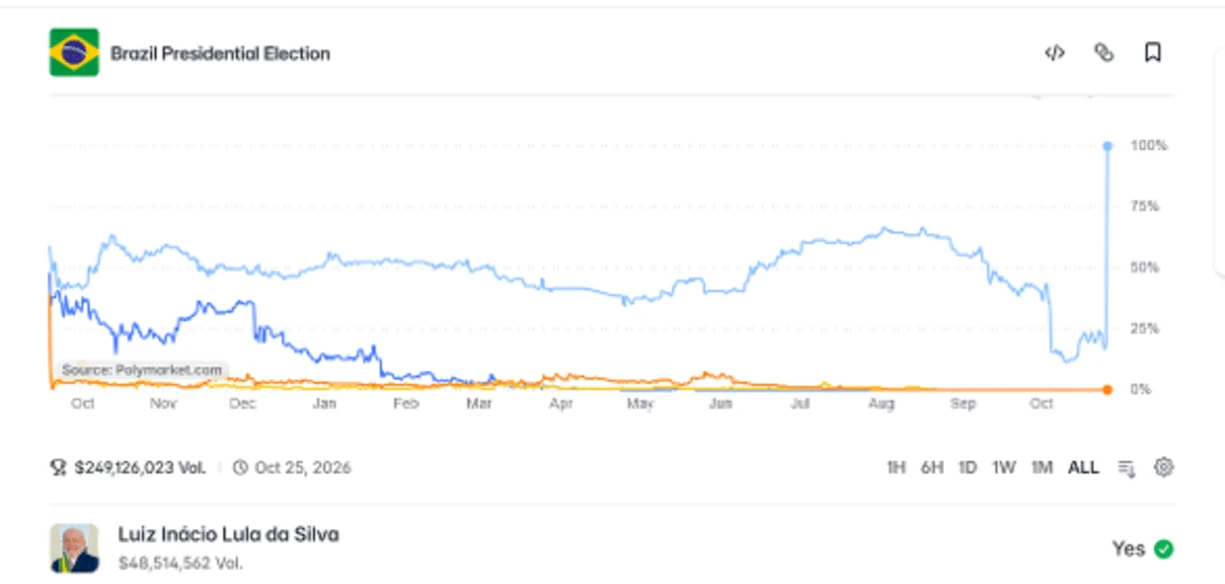
Over the weekend, Brazil incumbent President Luiz Inácio Lula da Silva rode a wave of support among working-class suburban voters to post a shocking victory over Flávio Bolsonaro in the country’s national presidential election.
In defeating his right-wing opponent, Lula became the first candidate since 1989 to capture the election after finishing second in the opening round of balloting. The victory appeared remote after Bolsonaro prevailed with approximately 47% of the vote in the first round on 4 October. A win by Bolsonaro, the Liberal Party candidate, pushed Lula’s odds on Polymarket down to 13.5% in the immediate aftermath of the outcome.
On the eve of the election, Lula rebounded somewhat, inching up a few points. Astute traders on Polymarket capitalised on the mispricing, with one earning a profit of $47,595. Others who failed to predict the upset took a bath, with a trader named “timetowander” incurring a loss around $27,100. The stunning result may represent the most glaring example of odds mispricing on prediction markets ahead of a major global election.
Nevertheless, it may be premature to draw a sweeping conclusion on any systemic flaws with prediction market forecasts from the Brazilian result. Lula’s victory comes less than two weeks before the US midterms, one Kalshi’s Tarek Mansour has described as “truly the first prediction market election”. One prominent researcher, David Lawant of Anchorage Digital, wrote on X that the public largely drew the wrong conclusion from how prediction markets handled the election in South America’s largest nation.
“Despite dramatic late twists and turns, they repriced to the new reality before the expert consensus,” he wrote. “Prediction markets show you where consensus is, in real time. What to do with that data, to predict and price the future, is still your job.”
Win some, lose some
While prediction markets on the outcome of an election have been around for decades, the phenomenon of trading heavily on a political race largely gained steam during the 2024 US presidential election. Weeks earlier, Kalshi won a key court decision on the legality of so-called Congressional Control contracts. The decision enabled prediction markets to offer a slew of contracts on the outcome of the election.
On election night, Kalshi handled millions in trading volume, including several seven-figure trades on US President Donald Trump after 10 pm ET. At Kalshi and archrival Polymarket, volume surged in the final weeks, with overall activity eclipsing $4.2 billion, according to Pew Research Center, a nonprofit fact tank.
Though most mainstream US networks predicted a dead heat in the ramp to election night, Polymarket placed the odds of a Trump victory over Kamala Harris at closer to 58%. Polymarket CEO Shayne Coplan later described the call as “gratifying”, telling Netflix that the result gave prediction markets a “level of credibility” that changed the industry entirely.
But in the two years since, there are a number of anecdotes where the pre-election odds appeared dramatically off. The most conspicuous case transpired in last year’s New York City mayoral primary, where former New York governor Andrew Cuomo saw his odds spike to 93% weeks before the primary.
Top prediction markets even gave Cuomo a 57% chance when voting closed at 9 pm on primary night. Not only did Zohran Mamdani score a decisive win over Cuomo in the first round of ranked-choice voting, he increased his margin with 56.4% of the votes in the final round.
More recently, prediction markets failed to capture public sentiment in Michigan and Wisconsin during those primaries. Traditional polls also whiffed on both; in Wisconsin an underdog trailing by 20%+ in the final polling still prevailed.
Prediction market trends abroad
Outside of the US, prediction markets also displayed flaws in last October’s Netherlands election. There, Dutch centrist Rob Jetten’s D66 party edged far-right leader Geert Wilders’ Party for Freedom despite slim chances on prediction markets.
Within minutes of the release of exit polls, the odds for D66 skyrocketed from around 5% to a near cinch.
In a post-election analysis, data from Polymarkets Analytics indicated that the patterns underscored “a test of conviction rather than foresight”, as traders hung onto the losing bets out of belief, wrote Sam Reynolds of Coinbase.
As with any major geopolitical event, a surprising outcome will generate copious hot takes on social media. Nic Carter is the author Murmuration II on Substack, a blog that covers the intersection of technology and markets — Carter has more than 785,000 followers on X.
Opining on the result, Carter wrote that prediction markets were “meant to provide a financial motive for sharps” to “research alternative data in the form of more accurate odds”.
Prior to the election, three major Brazilian polls forecasted a win for Bolsonaro, including one from prominent pollster Datafolha that predicted a two-point victory.
Anomalies in Brazil
There are other factors that suggest that the Brazilian results could be a one-off. A major one to keep in mind is that prediction markets are relatively sparse in Brazil, a nation with more than 200 million residents.
Bruno Centurion, a political analyst at Fatto Inteligência Política, told iGB before the election that the main public consumption for predicting the result is “inside financial markets”. Those markets also contained “some wishful thinking” based on patterns after the first round, according to the analyst. Centurion accurately predicted Lula’s upset.
On Monday, Carter responded to a post from Eric Wallerstein, a former staffer at the White House and the US Federal Reserve.
In a post on X that received at least 55,000 hits, Wallerstein wrote: “The lesson from Lula is that “prediction markets are just a function of polls — which are increasingly unreliable”.
Now serving as chief macro strategist at The Clocktower Group, an alternative asset management and investment advisory firm, Wallerstein added: “There’s no signal from betting odds, just more opportunity to speculate.”
The weatherman can be wrong
Before US voters go to the booths, the Brazilian outcome could clear up a misconception on the function of prediction markets in major elections.
In terms of framing, prediction markets are not meant to come up with a determination of whether an outcome is “right”, as Smarkets CEO Jason Trost puts it. Rather, the odds at a given moment are a “real-time price” gauge, he explained.
When the booths closed, prediction markets gave Lula about a 20% chance of winning, he notes. At the same time, Bolsonaro only led in the polls by a small margin of 51-49%.
Trost drew an analogy with a weatherman who is forgiven when a forecast for a slight chance of rain does not comes to fruition. At 20%, the odds of an event occurrence is still 1 of 5; the Lula victory represents the one occurrence.
“If the weather report says 20% chance of rain, nobody says the report was ‘wrong,'” Trost told iGB.
Implications for the US midterms
In the wake of the surprising results, Wallerstein posted on X that Brazilian futures tanked 11% on Monday, wiping out nearly all of its gains this year.
Wallerstein, who served as a special advisor on the White House Council of Economic Advisors in 2025, now expects a number of “surprises” during midterms.
Last week, Chuck Todd moderated a panel at the Next Predicts conference entitled: “Who Calls the Midterms: Polls, Models or the Markets?” Todd, a former moderator on NBC News’ Meet The Press, cautioned that retail traders could be clobbered on election night if they ignore nuances such as late reporting in certain jurisdictions.
He was joined by Columbia University economics professor Rajiv Sethi, an author of Political Prediction and the Wisdom of Crowds, a 2025 paper on the influence of prediction markets in the prior year’s presidential election.
While Sethi indicated in his review that markets were “clearly better” than models on the presidential winner, the former did better on down-ballots, specifically in House races.
He further warned that markets can be “very quick” in some cases, but also “very wrong”.
Slow the robots
Another insider, POPVOX co-founder Marci Harris, monitored the market fluctuations on the Brazilian election.
Harris formerly worked as a Hill staffer as legislative counsel on the House Ways and Means Health Subcommittee.
In observing the Brazil results, Harris told iGB that she was reminded by the “beauty of democracy”, noting that “the people are in charge, and people are wonderfully unpredictable”.
When US voters go to the booths on 3 November, prediction market activity on the midterms is widely expected to surpass $1 billion in notional volume. Even longtime wonks with decades in politics may predict a wrong outcome in Harris’ estimations.
“For anyone expecting the robots to take over, I think that’s what saves us,” she mused. “We’re so interesting and unpredictable that they’ll want to keep us around.”
Kyle Goldsmith, Martin Bjoerck and Jake Nordland contributed to this story

Matt Rybaltowski
Matt is primarily responsible for long-form feature coverage on complex sports betting scandals. He also provides coverage on finance, M&A and other technological developments.