
Eyes down: UK bingo’s licensing identity crisis

When the UK’s gambling statistics recorded another sharp increase in gaming machine revenue from licensed bingo premises, critics were quick to identify a troubling trend with one gambling harm campaigner suggesting bingo was a ‘trojan horse’ for gaming machine operations.
Indeed, according to the latest Gambling Commission figures released recently, gaming machines generated £461.7 million in gross gambling yield for bingo operators during the year to March 2026, compared with £242.1 million from bingo games. Machines therefore provided almost two-thirds of the sector’s combined £703.8 million in GGY.
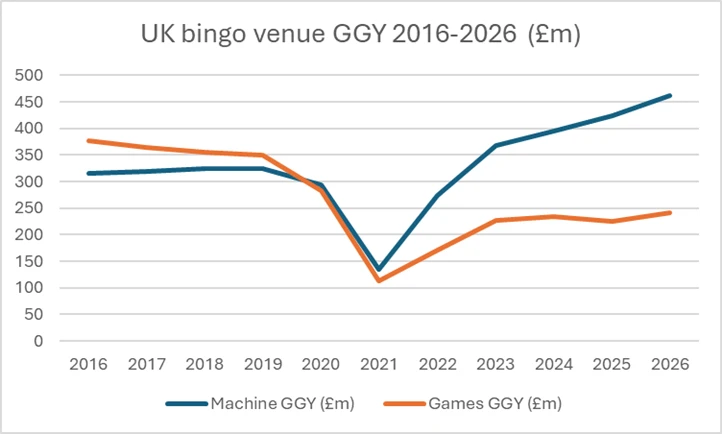
The divergence has become increasingly pronounced. Bingo premises machine GGY has risen from approximately £293 million in 2019-20 to £462 million in 2025-26, an increase of 57%. Revenue from Category B machines, the higher-stake products available in bingo premises, climbed from approximately £197 million to £361 million over the same period.
Category B consequently accounted for approximately 78% of bingo machine GGY in the latest financial year, up from around 67% in 2019-20.
Viewed in isolation, the figures might suggest that gaming machines have simply become more important to traditional bingo clubs. Machines have long helped large, labour-intensive venues meet their property, staffing and energy costs, particularly as attendances and the number of conventional clubs have declined.
But the aggregate data conceals a more fundamental change in the composition of the sector. A growing number of premises carry bingo licences while appearing, and operating, much more like adult gaming centres (AGCs).
BINGO?
The government acknowledged the problem in its October 2025 consultation on bingo licensing. It said there was a “growing number” of licensed bingo premises that predominantly offered gaming machines and were difficult to distinguish from AGCs. Some had machines occupying most of the floor space and presented the machines as their most prominent feature when customers entered.
Data supplied by the Gambling Commission represented the regulator’s best attempt to separate the economics of different bingo formats. Among operators running mainly or exclusively what the Bingo Association categorises as high-street bingo premises, less than 1% of GGY came from bingo games. Gaming machines generated the other 99%.
That compares with bingo contributing 51% of GGY for operators focused on traditional bingo clubs and 55% for operators concentrated in holiday parks.
The comparison suggests that “bingo premises” now encompasses at least two very different businesses. One is the recognisable destination club, offering scheduled games to hundreds of customers with machines as an ancillary but important revenue stream. The other is a smaller high-street venue in which machines are the commercial proposition and bingo’s role can be marginal.
Drawing a line
iGB took a look at the licensee information about Merkur Slots, available on the UK Gambling Commission website. It found that of the 340 Merkur Slots venues, 227 were classed as bingo venues and only 106 as AGCs. A quick look at Google street view will show that all of these “bingo” venues’ look like, and function as, AGCs, albeit with some wording on the windows saying “bingo played here”.
To complicate matters further, there is also a developing hybrid category between the two. Smaller-format venues can combine a credible bingo offer with machines and introduce the game to different audiences without replicating the traditional club model.
Drawing a line between legitimate innovation and a machine arcade operating under a bingo licence is the regulatory difficulty.
The problem with ‘substantive’
Under Gambling Commission social responsibility code provision 9.1.2, machines may be made available in licensed bingo premises only where “substantive facilities” for non-remote bingo are also available.
The internal and external presentation of the premises must also allow a customer reasonably to recognise it as a venue licensed to provide bingo. What counts as substantive, however, is not defined.
The Gambling Act does not specify how much floor space must be used for bingo, how many customers must be able to play it or what proportion of revenue should come from the game. There is no statutory minimum number of bingo seats.
The Commission deliberately resisted a universal numerical definition when it previously considered the issue, seeking to avoid an inflexible, one-size-fits-all approach. That flexibility has accommodated traditional clubs, holiday parks, electronic bingo and newer formats. It has also created room for premises in which the bingo provision is technically present but economically insignificant.
Electronic bingo terminals complicate matters further. The same tablet can offer bingo and gaming-machine content, although only one activity can be played at a time. A group of tablets might therefore demonstrate that bingo is available while also contributing to machine play.
The result is a test based on the availability and presentation of bingo rather than whether bingo is the venue’s principal activity.
Why the licence matters
The incentive is not necessarily a more generous allowance of Category B machines. Both bingo premises and AGCs can ordinarily make Category B3 and B4 machines available up to a limit of 20% of their total machine estate. The remaining machines must be lower-category products. Older premises have limited grandfathered entitlements, but the underlying machine ratio is broadly similar.
There are nevertheless important distinctions. Licensed bingo premises can offer forms of bingo unavailable in AGCs, where bingo is restricted to qualifying prize gaming. Bingo premises may also seek an alcohol licence, whereas customers cannot consume alcohol while gambling in an AGC.
The regulatory identity of the premises affects its customer proposition, presentation and the multi-operator self-exclusion scheme that applies. It can also influence how local licensing authorities assess the venue and the surrounding area’s gambling risk profile.
A machine-led premises operating under a bingo licence can therefore occupy a different regulatory position from an AGC offering an economically similar product.
The point is that in-person bingo and machine gambling do not carry identical risk profiles. The government’s consultation noted that survey evidence associates machine play with higher rates of problem gambling than land-based bingo. It said a venue primarily offering machines has a different overall risk profile from a club with prominent bingo facilities, regardless of the label on its licence.
Yet revenue growth alone does not establish increased harm. Nor does a high machine-revenue percentage automatically demonstrate that a traditional club is providing insufficient bingo. A relatively small number of higher-intensity products can generate substantially more GGY than hundreds of bingo seats. A revenue test would therefore risk misclassifying legitimate clubs whose bingo offer remains extensive but whose machines are more productive.
A sector transformed
The latest data from the UK Gambling Commission suggests the issue is becoming more pressing. Bingo Association data cited by the government showed the number of registered traditional clubs falling from 335 in December 2018 to 248 by August 2024. The latest data shows that as of March this year there were 714 bingo premises, up from 688 from the year previous. Growth in smaller high-street locations largely offset the disappearance of traditional venues.
The revenue mix changed alongside the estate. Machines provided 44% of licensed bingo-sector GGY in the year to March 2014. By March 2024 that share had reached 63%. The latest Commission data put it at 65.6% in 2025-26.
The debate is therefore not simply about machines taking a larger share within existing bingo clubs. It is also about the expansion of a venue format in which machines were the dominant commercial activity from the outset.
Drawing a new line
The government’s consultation proposed establishing a clearly defined bingo area in every licensed venue. Options included requiring 30%, 40% or 50% of the premises to form a continuous bingo area. Cabinet and in-fill gaming machines would be prohibited from that space, while tablets would have to offer bingo even if they also carried machine content.
The government also consulted on a minimum number of distinct bingo positions. The options included requirements for 30 or 40 seats, with an alternative formula linking the number of positions to the size of the bingo area.
For operators wishing to retain a predominantly machine-led offering, the consultation presented another route: conversion to an AGC licence. Such a move would mean losing the ability to offer most forms of bingo and potentially the ability to serve alcohol, as well as incurring licensing costs.
The policy challenge is to avoid shutting down genuine hybrid formats while preventing token bingo provision from being used to support what is otherwise an AGC.
A minimum seating requirement could provide a simple test, but the number would need to be low enough to accommodate credible smaller venues. A floor-space rule might better protect bingo’s visibility, although it could encourage operators to create nominal or lightly used areas merely to satisfy the percentage.
Boundary with AGCs is blurred
The most effective regime may ultimately require both: a recognisable area for bingo and a meaningful number of positions that are genuinely available for play.
The consultation closed in January, but changes at the top of government and within the ministerial team have left the sector waiting for a response.
None of this means that machine-led bingo premises are necessarily operating illegally. The problem is that the existing law has struggled to define how much bingo must be offered before a venue can credibly call itself a bingo hall.
A single licence category now covers everything from destination clubs with hundreds of bingo positions to high-street premises deriving 99% of their gambling revenue from machines. The government has accepted that the boundary with AGCs has become blurred. The question is whether it can redraw it without damaging the bingo venues the licence was designed to protect.