
Groupe Joa CEO Laurent Lassiaz: iGaming is not a threat to land-based in France
France is a country with a gambling industry in a state of flux. On the one hand, there is a mature and respected land-based sector; on the other there is the looming presence of iCasino, yet to be legalised, with an offshore market that is apparently thriving. Some studies have put the size of the country’s black market at €1.5 billion annually, which means not only significant tax revenue lost for the exchequer, but possibly the biggest offshore market in all of Europe.
We’ll come to that later though. First, meet Group Joa CEO Laurent Lassiaz. His route to the casino industry might seem from the outside to be circuitous, but in reality it makes perfect sense. Originally working as operations director for KFC and Pizza Hut in France, Laurent discovered what he describes as “the challenge of delivering a promise”, something that has stood him in good stead during his more recent casino industry career.
Making promises
“If you tell someone you will deliver their pizza in 30 minutes, that’s a promise – so you need to make sure you have everything in order to keep that promise,” Laurent explains. It’s a great lesson for anyone in hospitality, indeed any customer-facing role. After shaping KFC’s entry into the French market, Laurent found progression was only available in bigger roles – heading up the France operation, to heading up Europe, for example – and he didn’t want to become typecast as a food and beverage (F&B) specialist.
His talents had been spotted, however, and Club Med came knocking with an entirely new challenge: delivering consistency for their customers regardless of the holiday destination. “I liked the challenge so I took it on, and enjoyed it for ten years. It was really fascinating to develop the same customer experience in different countries with new rules and different workforces.”
Headhunted from F&B
The next call was from a casino industry headhunter. Luckily, Laurent’s background had him well prepared for the contact. As he says about the casino industry, “you have the F&B, you have some shows to organise, you have some events to welcome. The only difference is you have the gaming side, but this is only mathematic. You don’t design your product, you basically buy it and design what’s around it in terms of experience, service, design, quality of service and all the product that you can add around it to try to make the difference versus the competition.”
Speaking of the competition, Laurent’s Groupe Joa is the country’s second-largest operator with 33 casinos in total. France’s mature land-based market sustains just over 200 casinos, varying from smaller operations with 20 slots and two table games, up to integrated resorts with 500 slots, 20 tables and a variety of entertainment. Some European countries have ‘casinos’ which are actually slot halls with no live dealer games, but in France these are not permitted, it’s all Vegas-style slots and classic table games, sometimes supplemented with electronic table games.
Within this spread of casinos, slots are by some distance the main earner; France loves a good slot machine. The market’s GGR is around €2.8 billion, and slots represent between 75% and 82% of that figure.
Introducing a slot market
Slots were introduced to French casinos in the early 1980s and before their appearance casinos were solely table game operators. But the modern customer, Laurent notes, is not looking for slot play necessarily.
He tells iGB: “If you look at what’s going on right now, let’s assume that the slots are played by older players, retired people enjoying the casino for a long time. The new players are much younger and their focus is not really on slots. It’s much more on table games and on electronic table games. Because you can play it for cheaper. But definitely more table games because they have much more in the sense of controlling the game, trying to beat the casino versus playing on the slots which is perhaps a bit boring because there’s not much interaction with the slot machine.”
The sociable aspect of table gaming is something slot manufacturers have been trying to emulate for decades, but it might be fair to ultimately conclude they’re just very different players. Older players, Laurent observes, “come to the casino to socialise. They have a budget. They know by experience that they won’t really make huge money. So they are buying time and experience which is a bit different from the younger audience because those guys, they want to make money. And that’s the reason why they want to prioritise games where they have the feeling of control.”
Monaco, an exception
The French casino market is essentially one huge locals market, with one obvious exception: Monaco. And as Laurent notes, it attracts a very different player to the average French casino. “Monaco is a very specific market, which doesn’t work at all like the French one. Of course, they have some French players coming to have a look, to experience the Monaco ambience. But where they make the money is wealthy people flying in to spend their money because they have dedicated space for high rollers. That’s not at all the customer profile of the French casinos.
“The average spend per entry in my group of 33 casinos is €80. We are very far from the movie stereotype that you see in Casino Royale, for example, with people spending lots of money, having some big luxury car. In France, it’s a popular activity and has nothing to do with the profile of the Monaco casino.”
Positioning
The Groupe Joa CEO makes a very important point here. Because the French casino industry is aimed at locals, it’s more resilient than a destination resort might be and less exposed to influences such as the cost of fuel.
“For the French population, the casino is a local leisure destination; it’s part of the local list of leisure activities that you can do. And that’s the reason why it resists a poor economic environment so well, because when the economy is bit shaky like it is today, for example, with the war, with the price of energy and so on … we are suffering less than the rest of the industry because it’s a local type of leisure,” he explains.
“In difficult times people tend to postpone a big expense such as changing the car, extending the house, expensive travel. But local leisure, local pleasure, this is the last thing that they will sacrifice. That’s the reason why we keep playing this positioning, being not just a gaming destination but a leisure destination. That’s the place where people socialise and meet on a Friday evening for a drink.”
Dating back to Napoleon’s reign
He admits it is quite specific to the French market, but it’s also linked to regulation. “If you operate a casino you need to operate three different activities: firstly gaming, with the second one being the entertainment and thirdly the F&B business. So no matter what size, every casino in France has those three facets. That’s why the local population sees the casino as a leisure destination.”
This originally comes from Napoleon’s decision back in 1806 to assign casino licences according to very strict criteria: “Our Minister of Police will make particular regulations for places where mineral waters exist during the water season only, and for the city of Paris.” This meant that early licences were granted only to places with thermal spas, eventually spreading to more standard tourist destinations like seaside resorts.
Making the difference
With this focus on locals, Laurent jokes that operators only lose players “when they change their nation, to the cemetery!” It’s understandable that when a sector is so well furnished, players have a lot of choice and will naturally move around as the mood takes them. So it’s up to the operators to make their points of difference.
As Laurent puts it, players “switch from one casino to another because no matter where you live, you have two or three casinos nearby. And that’s very important because on the gaming side, your direct competitor can have exactly the same slots with exactly the same RTP.
“The only way for you to make it different is the customer journey. So the way you welcome people, the way you treat them, the way you reward them, the way you are able to propose something other than the game, the quality of food that you’re able to sell, the number of surprises, number of events that you are able to design, that’s what makes the difference.”
With this in mind, what does Groupe Joa do differently to keep customers happy? “Of course, it’s not like in the fast food industry, where every property has the same signage on the roof, are really the same entity, with the same quality of service, the same spirit.
“In terms of size, in terms of what each offers, [Joa casinos] are all different. We have one or two which are much bigger than the average, what you might consider a flagship casino.”
Next generation of casinos in France
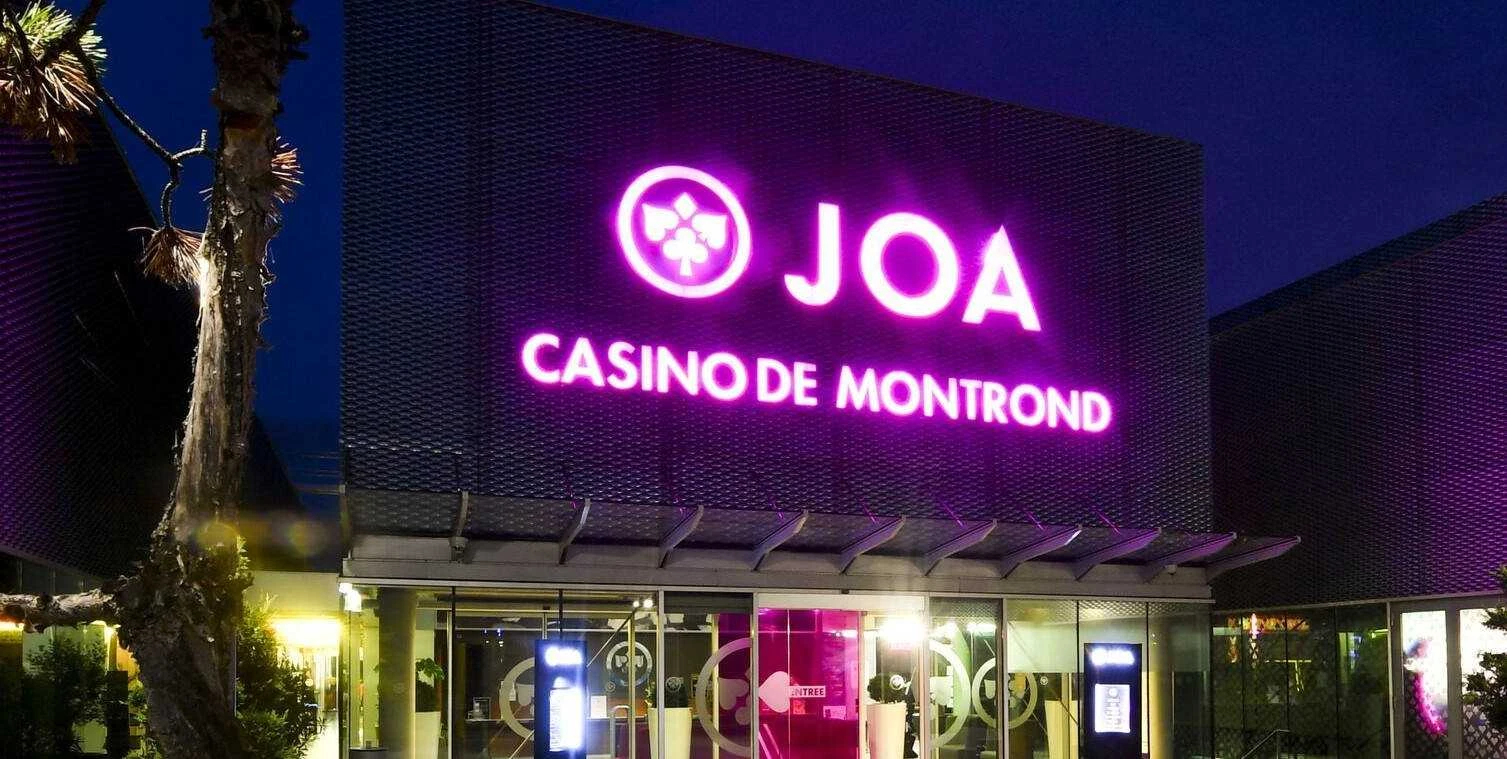
He takes Montrond-les-Bains as an example. It’s a casino Groupe Joa built 15 years ago in an effort to showcase its vision for the next generation of casinos in France. He describes a building with a superb design, super modern, and a layout that is half gaming and half non-gaming. From a non-gaming perspective it provides a sports bar, restaurant, disco, bowling alley and a showroom.
This split is unusual in French casinos, especially considering slots are the dominant revenue earner. Joa has consciously aimed to offer a broad entertainment and F&B package to get people in the door, and dedicated a greater proportion of floor space to doing this.
Laurent elaborates: “Across the Joa portfolio, it’s a real 50-50 space allocation between gaming and non-gaming. This is part of the strategy of the group but is also something very specific to Groupe Joa. Because since the very beginning of this strategy, we decided to use the non-gaming activities as a traffic builder to recruit and to attract a younger audience.”
The online elephant
No discussion about the gambling market in France would be complete without bringing iGaming into the mix. Today iGaming remains unregulated in the market, and efforts to reform this decision appear to have stagnated. The land-based sector doesn’t see online as a threat because of everything we have already talked about in this article, says Laurent.
“I don’t see the online casino as a potential danger because we basically bring so many things on top of gaming that help us to resist this potential proposition.” But in our conversation, Laurent agrees heartily that the French industry could benefit from online licences tethered to land-based casino operations: “My view is that it would be a huge new vertical for us, and I’m the defender of the evolution from brick-and-mortar to click-and-mortar. I think it would be a natural extension of what we already do on a regular basis.”
It transpires that France has a particular issue which makes introducing online casino gaming less black and white than it might be for other countries. Laurent explains: “Of course, illegal gambling is everywhere in Europe. When it comes to online casino, first of all, there’s no real proof that when you regulate a country it tackles the illegal operators.
“There are plenty of examples where the regulator decided to regulate online but in such a way that it’s a nightmare for the customer journey [and] the people keep playing on illegal platforms because they have a higher RTP and because they don’t pay tax.”
Land-based tax supports local councils
He admits the onboarding experience across black market operators is much simpler, as players don’t have to submit detailed personal financial information. “France’s brick-and-mortar casino sector is the largest in Europe with 200-plus casinos, and it’s well connected to the local territories – it is very plugged in to the local and financial environment,” says Laurent.
He acknowledges the huge efforts that go into organising events and shows which benefit the entire region. This makes up part of the sector’s concessions terms. Notably, Laurent highlights the land-based sector’s tax on GGR, which is paid to the city where a casino is located.
“The regulator is super afraid of breaking a well-balanced business which is very connected to its environment. Here in France the local contribution to the local city and the local territory is huge. We quite often provide for up to 50% of the city’s expenses. So everybody is super-scared of breaking the toy.”
Groupe Joa sauce
Just where can one of the country’s leading operators grow, in a mature market? The obvious answer is acquisition, but Laurent is adamant that this is not the only path to improving Joa’s fortunes. “There are still avenues for growth that we are working on at present,” he teases. Organically, he says, Groupe Joa is seeking to add new products to its existing portfolio.
“We keep testing new F&B concepts, new escape rooms, things like that to add to our existing casinos. When we do that, we develop the traffic, we develop the GGR. So organically, there’s still room to improve. That’s number one. Number two is acquisition. There’s still some small groups or independent players in the market that we could acquire in the future.”
Expansion is also a possibility, as Laurent nods to regions in France which remain without a local casino proterty. “We can intensively lobby the government and the gaming authority to look at the law, to be able to equip those non-equipped regions and to be able to launch new tenders for casinos.”
Perhaps most excitingly are the group’s international prospects. “We call it the Joa Sauce, our secret sauce to basically buy a casino, put our product standards in and develop it. This could be applied to other groups in other countries. Probably 30% of my time right now is dedicated to identifying the right targets in Europe that could be a good acquisition for us and that could welcome a Joa Sauce injection,” Laurent concludes.