
How Betclic reignited its player props strategy with WSF Odds

The 2026 FIFA World Cup was shaping sportsbook strategies long before the opening whistle on June 11.
With 48 teams going for glory across Canada, Mexico and the USA, there will be winners and losers on the pitch – and off it. Across the betting sector, operators have been gearing up for a competition that promises to be every bit as intense as the actual sporting action.
As punters increasingly engage with player performances, statistics-driven markets and bet builder products, operators are under pressure to deliver deeper football content, faster settlements and more engaging experiences during one of the biggest betting events in history.
Why Betclic opted to evolve its offering
Betclic Group is one business that looked closely at its football betting offering and concluded that changes were required. With its strong focus on product experience, Betclic – one of Europe’s leading operators and the official betting partner of the French Football Federation – identified areas where more could be done to meet evolving customer expectations.

Martin Houdbine, Betclic’s chief business officer, said the business had identified a clear shift toward more personalised and player-centric betting.
At the same time it was determined that, internally, manual processes were becoming a bottleneck, while props could not be scaled in a way that matched the operator’s ambitions.
Crucially, time-to-market for new products and markets was identified as being too slow.
“Our offering on player and team props was relatively limited and selective,” Houdbine said.
“We focused mainly on high-demand markets such as first goalscorer and anytime goalscorer, assists in top competitions only, and basic team stats like corners and cards.”
In terms of pricing, Betclic deployed manual compilation for markets around major leagues and events, while also using derived pricing models that extrapolated odds from core football markets.
“This approach worked to an extent, but it had clear limitations,” Houdbine said. “Firstly, there were scalability issues as it was hard to cover long-tail competitions or niche props.
“In addition, there was a slow time-to-market, the risk of inconsistency across markets and difficulties in keeping pricing accurate.”
Finding the right solution
To overcome these limitations, Betclic called on WSF Odds – a joint venture between football data and analytics specialist Wall Street Football (WSF) and sports trading leader TradingLab.
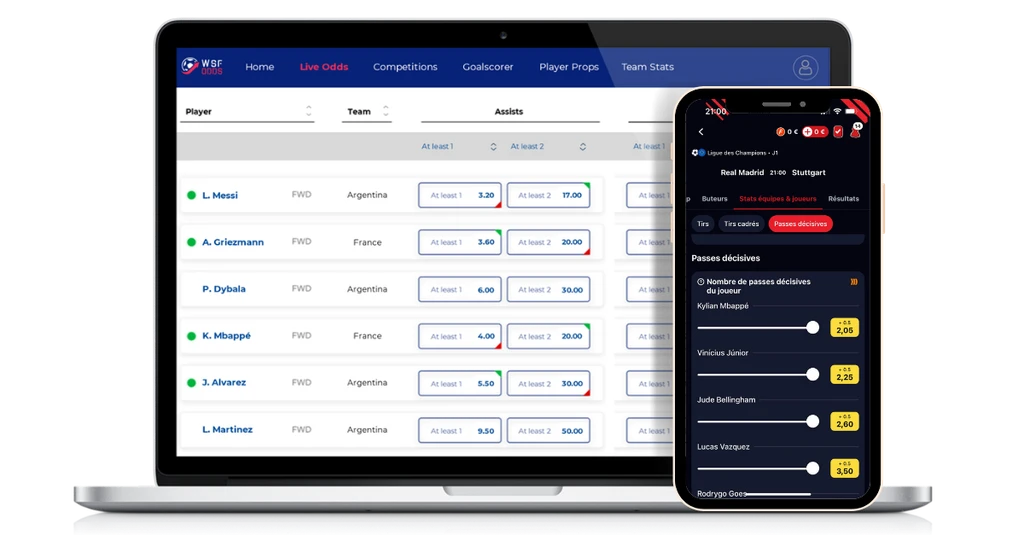
WSF Odds provides a broad catalogue of player, team and match performance markets across more than 90 football competitions worldwide. Its ecosystem combines official data, AI pricing models, proprietary algorithms and expert trading validation to deliver dynamic performance-based betting markets designed to increase both engagement and gross gaming revenue.
By partnering with WSF Odds, Betclic was not only able to add more markets, but also enable a more dynamic and engaging product experience at scale.
WSF chief executive and co-founder Giovanni Bertoli explained why the supplier is able to help operators provide the service that their customers deserve.

“Football fans were already thinking in a player-led way long before the betting product caught up,” Bertoli said.
“They follow shots, passes, assists, cards and substitutions every week. Operators knew this, but pricing player and team props correctly, especially live, is a different technical challenge from standard match betting.
“Most couldn’t do it in-house without adding significant manual trading pressure.”
Creating a smoother user experience
For Betclic, however, expanding the breadth of football props was only part of the challenge. Just as important was ensuring that the markets felt intuitive and accessible for users across both desktop and mobile channels.
The operator worked closely with WSF Odds to integrate props naturally into its existing sportsbook experience, with a particular focus on avoiding overly complex navigation or overwhelming customers with too many selections at once. Rather than separating player props into standalone areas, Betclic prioritised a structure that clearly differentiated match, team and player markets while surfacing the most relevant betting opportunities first.
‘Using an official feed allows us to ensure consistency and transparency, reduce disputes and customer support load and settle bets faster and with more confidence’
Dedicated live betting displays were also introduced to support quicker decision-making during matches, helping props feel like a seamless extension of the wider sportsbook experience rather than a specialist product aimed only at expert bettors.
Importantly, WSF Odds’ feed of official data from federations and leagues also elevates trust between player and operator, as well as satisfying regulatory obligations, delivering benefits for Betclic.
“With player props especially, you deal with very granular data, such as shots and passes,” Houdbine explained. “Small discrepancies can quickly lead to customer frustration, while definitions of player props can vary from one operator to another. “Using an official feed allows us to ensure consistency and transparency, reduce disputes and customer support load and settle bets faster and with more confidence. The official feed is not just an operational benefit – it directly impacts user satisfaction, brand trust and capacity to operate in regulated markets.”
Future of football props
The rapid rise of football props shows little sign of slowing with the 2026 FIFA World Cup. According to Betclic, player props now account for 20% of all football stakes across its sportsbook, with markets such as anytime goalscorer, shots on target and assists proving consistently popular among users.
Houdbine said there has been a clear shift toward more entertainment-led and statistics-driven betting behaviour, with players increasingly engaging with individual performances and match narratives rather than simply betting on final scores.
“What’s interesting is that users are not just betting on outcomes anymore – they’re betting on stories,” he said. “Props contribute to higher engagement and also tend to increase the number of selections.”
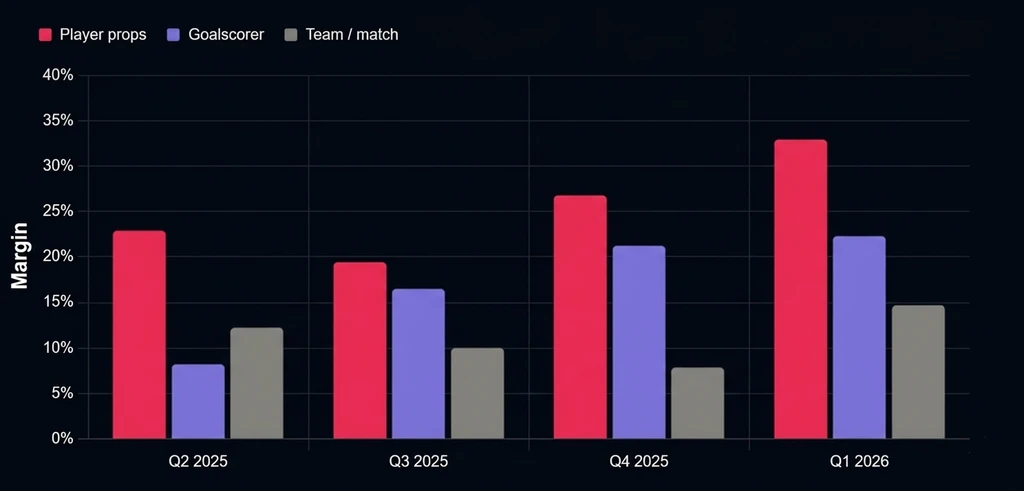
Chart: WSF Odds Data across operators in 2025/2026
For WSF Odds, that evolution reflects broader changes in how football fans consume the sport.
“Bettors are more stats-literate than five years ago,” Bertoli said. “Fantasy football, data journalism and performance apps have changed expectations. Customers arrive with specific knowledge about players and performances, and props markets speak directly to that behaviour in a way traditional match betting cannot.”
Bertoli also believes continued growth in Bet Builder products will further increase demand for deep and accurately priced player props, particularly as operators look to differentiate their football offering during major tournaments.
“You can’t build a good Bet Builder on three player markets,” he said. “You need breadth and correct prices.”