
Hedging risk via prediction market contracts

Los Angeles ice-cream shop 28 Wishes says sales fall by about 20% when the temperature drops below 70°F (21°C). Since April, its owners have put about $20 a day on Kalshi weather contracts and report profits of up to $1,500 a month.
A payout can offset lost sales on a cold day, but the hedge is imperfect. The contract settles on the temperature at a selected weather station, not the shop’s actual sales. It could therefore pay when the shop remains busy or fail to pay when cold weather keeps customers away.
This mismatch is called basis risk. To limit it, a business must choose a weather station, temperature threshold and time period that closely match the conditions affecting its revenue.
Prediction markets have made thousands of events tradeable, but a tradeable contract is not automatically a useful commercial hedge.

28 Wishes uses prediction markets to offset some of the revenue lost when temperatures fall. Source: 28 Wishes Ice Cream Shop.
A wider risk pool
Indemnity insurance pays against a covered loss. Parametric insurance can settle against an agreed trigger, but is still written for a customer with an insurable interest.
Event-contract traders need not suffer any corresponding loss. A business hedging lost revenue can trade against weather forecasters, sports specialists, market makers and recreational traders. Their combined risk appetite can create liquidity for exposures that would otherwise require bespoke underwriting.
Exchanges provide the market infrastructure, but not the exposure analysis, structuring and distribution needed to turn contracts into business hedges. Where natural liquidity is thin, specialist capital providers must also price and hold the risk while managing correlated exposures across customers.
Kalshi advertises more than 8,000 live markets, while Reuters reported $27 billion of trading on the platform during the 2026 World Cup. The commercial test is whether that infrastructure can support repeatable business hedging.
Turning exposure into a hedge
Consider a New York bar that expects to lose $50,000 of profit if the Knicks miss the conference finals. At 20 cents, 62,500 ‘Knicks miss’ contracts would cost $12,500. If the Knicks are eliminated, the contracts pay $62,500, producing a $50,000 gain before fees. If the Knicks advance, the contracts expire worthless and the hedge costs $12,500.
The position only works if the bar’s $50,000 figure is sound. The owner must judge how many home games are at risk and what each contributes, account for staffing and stock already committed, decide how much to cover and adjust as the series develops.
Few publicans will manage that unaided as prices and exposure change. Some may use AI tools to analyse and adjust their exposure; others will seek advice from domain experts. In either case, regulated distributors can arrange compliant execution.
Supplying capacity
Past volume can understate how much a business can hedge. In June, Susquehanna’s Jeremy Maletz said the firm could quote tens of millions of dollars of risk in a contract with only about $100,000 of past trading. It could do so if the market’s price discovery and Susquehanna’s own checks gave it confidence in the price. Specialist market makers can therefore supply far more capacity than past turnover suggests.
That capacity must be managed across customers. Ten unrelated bars hedging the same Knicks result creates one concentrated exposure for the provider. The same problem arises when businesses hedge the same storm, election or policy decision. A provider must aggregate positions, assess correlations, set limits and decide when to hedge or reduce exposure.
Capital is another constraint. A standalone Kalshi event-contract position is generally collateralised against its maximum possible loss. If a market maker buys 100 million ‘No’ contracts at 99 cents when ‘Yes’ is priced at one cent, it must commit $99 million. If ‘No’ wins, the contracts settle for $100 million, generating a $1 million profit before fees. If ‘Yes’ wins, the market maker loses the $99 million committed.
That capital remains tied up until settlement. A long-dated position can therefore lock up a substantial sum for a small potential return.
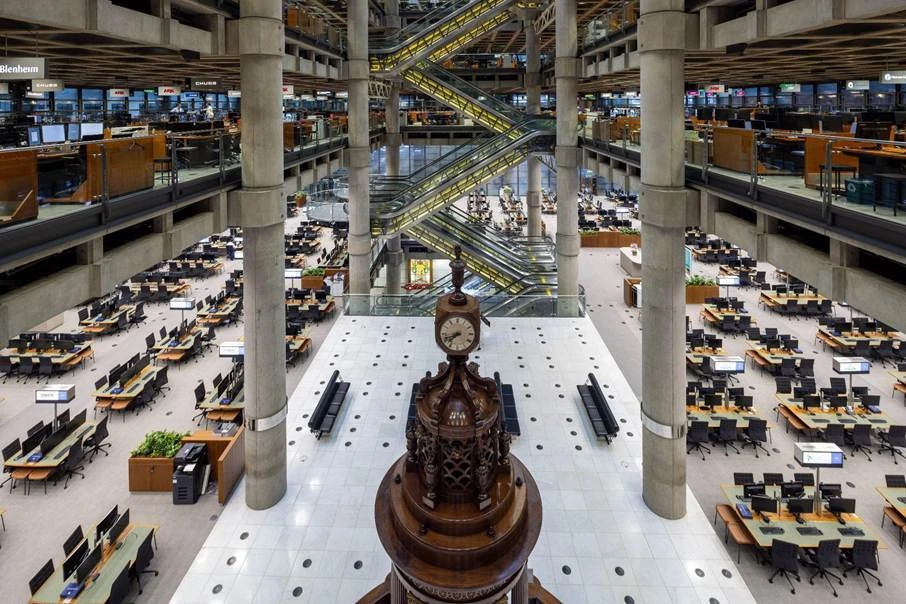
The Lloyd’s Underwriting Room, a marketplace built around specialist risk selection and capital. Source: Lloyd’s.
Settlement and regulation
Commercial users also need confidence in settlement. In April 2026, abrupt temperature jumps at Paris Charles de Gaulle Airport settled profitable Polymarket positions. After examining the data and equipment, Météo-France filed a police complaint alleging interference with an automated data-processing system.
For a business, the settlement source, treatment of corrections, fallback data and dispute procedures all affect whether the hedge performs as expected. A July CFTC staff advisory reiterated that registered exchanges should identify settlement sources before listing contracts and assess their reliability, objectivity and resistance to manipulation.
Regulation will shape how these markets scale globally. The same hedge may be available in one jurisdiction and restricted in another. This creates a role for distributors that can navigate different regulatory regimes and arrange compliant access.
Waterhouse VC View
The most credible early commercial uses are short-dated, data-rich exposures with objective settlement sources and enough recurrence to standardise. Catastrophe and other long-tail risks require bespoke analysis and tie up capital for longer.
The intermediary layer is likely to be software-led rather than purely advisory. A platform could use a business’s operating data to estimate its exposure, identify suitable contracts, recommend the hedge size and execute within agreed limits. Firms combining proprietary data with direct exchange connectivity should therefore scale more efficiently than traditional advisers.
Waterhouse VC is already working with White Swan Data on a prediction-market strategy that provides liquidity on regulated exchanges. Its initial focus is sport. The same disciplines of pricing, portfolio construction, collateral management and execution apply elsewhere, but the underlying data and pricing edge do not transfer automatically. We therefore expect specialist teams to emerge around individual risk categories as commercial demand develops.