
Sex sells… or does it? Can Novig leverage its Sydney Sweeney controversy?
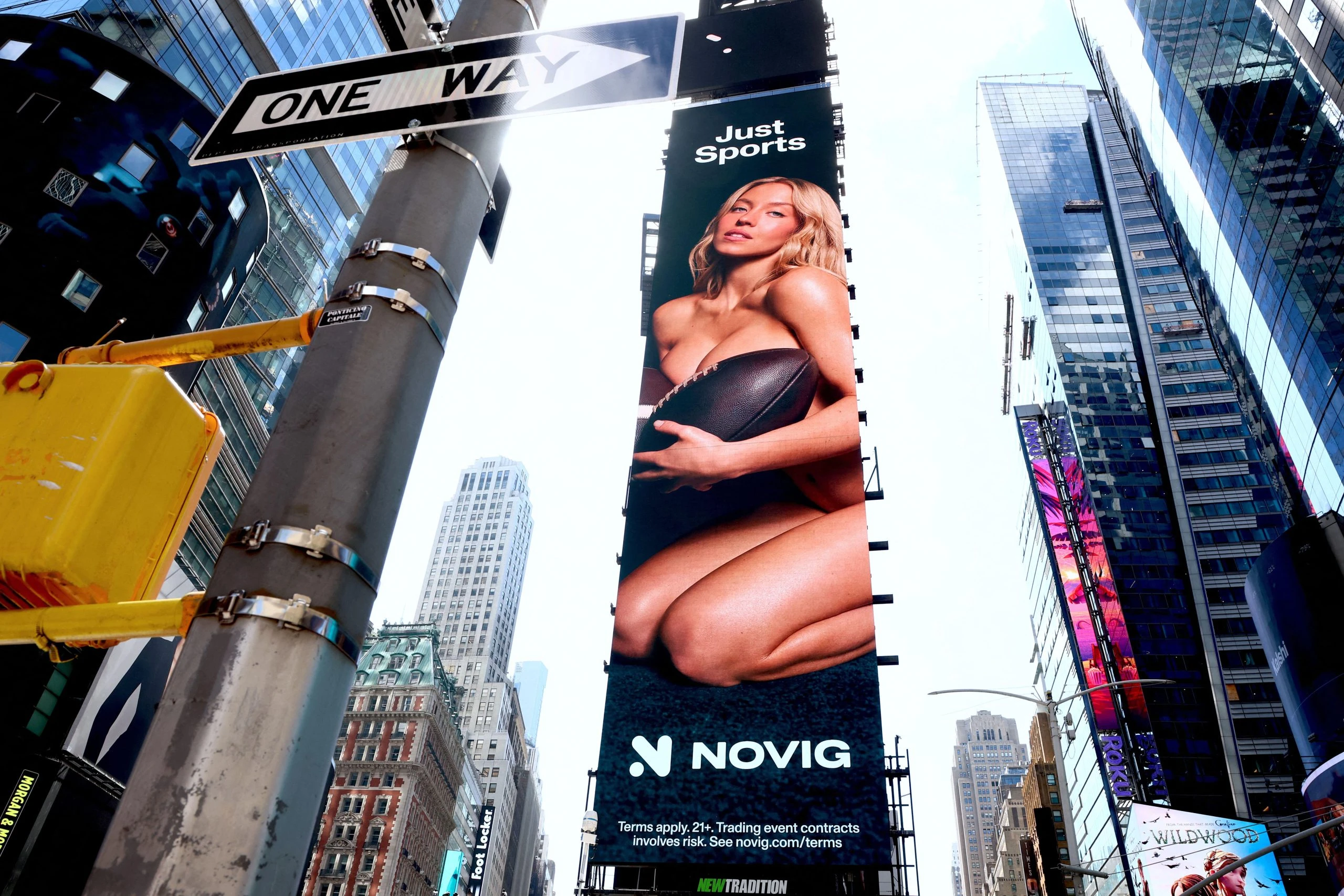
Novig’s provocative Sydney Sweeney campaign has delivered the prediction markets challenger brand a level of attention that conventional advertising might never have achieved. But as former Paddy Power and William Hill communications executive Tony Kenny points out, turning a viral hit into funded accounts and making the Novig name stick will be the harder task.
If the purpose of advertising is to get people talking, Novig’s “Just Sports” campaign has already worked.
Launched ahead of the new NFL season, the campaign features actor Sydney Sweeney naked or partially clothed, with strategically positioned footballs, boxing gloves and other sporting equipment preserving her modesty. Its central joke is that Novig offers “just sports” – no political, war or death markets of the kind available elsewhere in the prediction market universe.
Sweeney, who supposedly approached Novig about working together and has become an equity holder in the business, was closely involved in creating the campaign. She told Complex that the concept was fun and aligned with her interest in sport.
The backlash
The imagery swiftly travelled far beyond Novig’s existing audience. It also generated a backlash led by female athletes who argued that the campaign reduced women’s place in sport to sexual display.
Former UCLA gymnast Gracie Kramer responded with footage of herself competing under the caption: “I don’t know what Sydney Sweeney was doing, but this is what a woman in sports looks like.” British sprinter Amy Hunt, Olympic swimming champion Ariarne Titmus and water polo player Tilly Kearns were among those who also criticised the campaign.
International rugby player Sofie Fella questioned why money was being spent on such advertising rather than being directed into women’s sport, while other critics argued the campaign undermined efforts to have female athletes judged for their achievements rather than their appearance. The dispute was subsequently covered by outlets including the BBC and the New York Times.
Novig Chief Executive Jacob Fortinsky defended the campaign, saying the company was “hugely supportive” of women’s sport and had not intended Sweeney to represent female athletes. The actor also responded by pointing to previous nude photoshoots involving elite sportswomen.
The argument has provided Novig with acres of publicity. Kenny, the former head of sponsorship and PR at William Hill and previously a senior communications figure at Paddy Power, says the campaign has undoubtedly succeeded at the opening stage of the customer-acquisition journey.
“It has done a brilliant job of getting that attention,” he says.
“Absolutely, at the top of the funnel it has created awareness. Interest and searches are happening, and downloads are happening. The commercial questions are whether people progress to registration and a funded account, and then whether Novig retains them and creates value from those customers. We are still at an early stage.”
Going viral
A viral advert can produce views, searches and app downloads, but these don’t necessarily translate into depositing customers. Signing up to a prediction market requires more commitment than sharing or commenting on an advert and considerably more than buying a product directly associated with the celebrity wearing it.
Kenny contrasts the Novig campaign with Sweeney’s previous work for American Eagle. Seeing her wearing a pair of jeans may encourage a consumer to buy those jeans. Seeing her surrounded by sports equipment does not automatically explain why someone should open a Novig account, deposit money and trade a contract.
“This is not a free trial; people have to put in their hard-earned cash,” Kenny says. “That is a stretch for any gambling company.”
Novig can track traffic arriving through links embedded in its advertising and social channels. What outsiders cannot yet know is how many campaign-driven downloads became registered users, how many of those users funded an account and whether they returned after placing an initial trade.
Nor can the campaign’s effect on activity be easily separated from the seasonal uplift created by the beginning of the NFL season.
Controversy more recognisable than the product
For Kenny, the bigger question is what Novig now wants its brand to mean. The company has secured attention, awareness and at least some name recognition. But Sweeney and the controversy remain far more recognisable than the product being sold.
“Novig has attention, awareness and some recall, but what does it want to be associated with?” he asks. “Sydney Sweeney is now an equity partner. Is she going to be the face of Novig, or will the company pivot? From a communications and marketing perspective, the interesting question is: what next?”
That is particularly important because Novig is not a self-explanatory name for a general audience. Industry insiders and experienced bettors may recognise it as a reference to ‘no vig’ – the claim that customers can trade without a conventional bookmaker’s margin – but many of those encountering the campaign will not.
There is also a difference between manufacturing controversy and establishing an enduring challenger identity.
The Paddy Power example
Kenny saw that first hand at Paddy Power, where provocative stunts worked because irreverence was embedded in the company’s personality. The bookmaker had developed a consistent voice and its audience knew it was in on the joke. The same tactics employed by another operator could feel forced.
“Paddy Power’s irreverence is authentic to the brand, and it creates shareable content,” Kenny says. “That is the key.”
Novig could attempt to occupy a similar position in the US prediction market sector, presenting rivals such as Kalshi and Polymarket as comparatively corporate and conventional. But sustaining that identity across a market as large and culturally varied as the US would be a substantial undertaking.
It would also require the operator to keep producing campaigns that attract attention without merely repeating the same trick. If every subsequent advertisement relies on Sweeney and sexual provocation, the impact will diminish. If Novig changes direction too quickly, the first campaign may remain famous while the brand behind it is forgotten.
“This will be a non-story next week,” Kenny says. “What does it do as attention starts to die down? Does it flood the market with more ads?”
That is the test the initial viewing figures cannot answer. Novig has shown it can seize a moment and overshadow campaigns produced by much larger competitors. It has not yet shown that the resulting audience understands its proposition, remembers its name or wants to become a customer.
Sex may sell. For Novig, the unresolved question is whether it can sell sports prediction contracts or merely Sydney Sweeney.