
Prediction markets top of mind as CFTC nominees testify before Senate committee
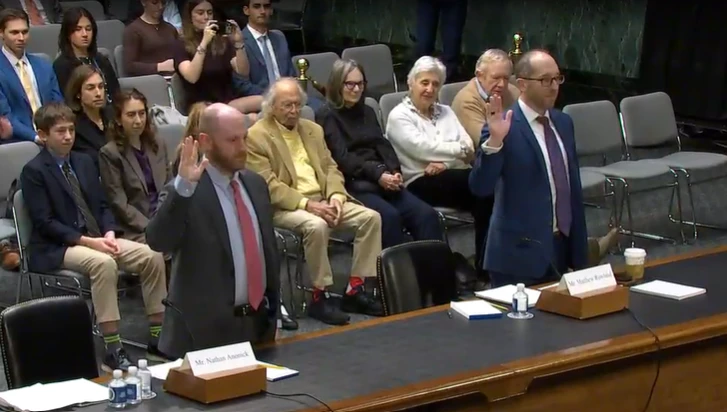
The direction of prediction market regulation in the US could change in the near future, as two nominees for the Commodity Futures Trading Commission testified before the Senate Committee on Agriculture, Nutrition and Forestry on Tuesday.
Nathan Anonick and Matthew Rowland are looking to become the second and third CFTC commissioners under US President Donald Trump’s second term, as CFTC Chairman Michael Selig has served as a lone commissioner for nearly a year. Typically, the CFTC features five commissioners, no more than three of whom can be of the same political party. Trump submitted the long-awaited nominations last week.
Anonick is a Republican who serves as derivatives counsel for Arkansas Senator John Boozman, Ag Committee chairman, and Rowland is a Democrat who serves as the committee’s CFTC detailee.
The questions the nominees faced largely toed party lines — Republican committee members were interested primarily in agriculture and commodities while Democrats harped on prediction markets and staffing cuts at the commission.
Neither nominee embraced or rejected the CFTC’s approach to regulating prediction markets, but both pledged to address stakeholders’ concerns and bolster the ranks at the commission, which was appreciated by committee members from both parties.
“I think that there is likely to be a Supreme Court decision (on prediction markets) sometime within the next term or the one after, and of course we’d be bound by the court’s decision on that,” Rowland said.
As a Republican, Anonick faced more direct questioning on the issue from Democratic members, to which he pledged to follow any court rulings and approach the issue with a “robust, thorough fact-finding process”.
Nominees pressed over prediction markets
Given their experience with the committee, both nominees were familiar to members and each other. Both were complimentary of one another and agreed that more commissioners are needed for the CFTC to work best. Even if both are confirmed, there are two more spots to be filled, at least one of which must be Democratic. Democrats saw huge gains in the recent midterm elections, winning control of both Congressional chambers. Rowland’s term would run through 13 April 2028 while Anonick’s would expire 19 June 2031.
With regard to sports event contracts on prediction markets, the fluidity of the situation made it difficult for the nominees to cast broad judgments. The CFTC is in the midst of a rulemaking proposal for prediction markets, and there is an avalanche of ongoing litigation involving both the commission and prominent prediction market operators like Kalshi and Polymarket.
“I think it’s important that as part of that rulemaking, which is still ongoing and which I hope to be able to participate in if confirmed, that we really think long and hard about balancing public interest against the economic usefulness of these contracts,” Rowland said in reference to the commission’s public interest test for contract markets.
So far, four federal Circuit Courts have opined on prediction-market cases. The Ninth, Sixth and Fourth Circuits have ruled in favour of states’ jurisdiction, whereas the Third Circuit ruled in favour of federal preemption. Anonick said that split makes the matter “complex” and “confusing”.
Notably, Minnesota Senator Tina Smith asked the nominees about two federal gambling-related laws: Did the Supreme Court’s repeal of PASPA establish states’ rights over gambling regulation and does the Indian Gaming Regulatory Act give tribes jurisdiction over gambling on their lands? Both answered yes.
Staff, enforcement concerns for CFTC
The most bipartisan topic of the hearing was staffing concerns. In addition to the lack of commissioners, the CFTC has seen significant cuts to staff counts and enforcement personnel over the last year. According to the US Office of Personnel Management, CFTC staff numbers at the end of 2025 were 21% below the previous 10-year average. The commission’s annual report from last year also showed significantly less enforcement actions in 2025 than previous averages.
“I certainly, if confirmed, would take a deep dive into exactly what the staffing numbers are, what the plans moving forward are and where the folks in the building that are privy to that kind of information think there needs to be additional technical expertise or changes,” Anonick said.
Rowland, for his part, said he looks forward “to learning more about Chair Selig’s plan to hire up new staff” and agreed that “ensuring that the agency is appropriately staffed and resourced is, I think, a very high priority”.
The hearing adjourned without a vote Tuesday, with the record being left for two days. Both the committee and the full Senate need to approve the nominations in order to become effective.