
Retention goals: How gamification is bringing a new dimension to sports betting

Players who have grown up with social media and entertainment offerings at their fingertips are increasingly bringing their digital habits into the iGaming space.
Social feeds, creator channels, mobile games and sports communities are more prevalent than ever, providing digital natives – and increasingly older players – with interactive experiences and, above all, reasons to return.
Deloitte’s 2025 Digital Media Trends report shows that younger audiences are spreading their entertainment time across streaming, social platforms, gaming and other digital media. This helps to explain why these audiences have become accustomed to progress-led experiences.
Changing the retention model
For operators, those expectations are changing the retention model, according to Soft2Bet’s chief product officer Yoel Zuckerberg. Whereas classic tiered VIP programmes still have a place, they do not match how many younger players behave online, he argues.
Instead, when players come in to place a bet or start a session, the surrounding product experience needs to provide them with the progress, feedback and status they have grown to expect – and a reason to return.
In this context, Soft2Bet’s MEGA (Motivational Engineering Gaming Application) portfolio gives casino and sportsbook brands a standalone gamification solution.
At its heart, MEGA provides a range of gamification engines that operators can customise by reward type, bonus trigger, user segmentation and difficulty level. Launched in early 2026, the latest addition to the MEGA portfolio – MEGA11 – brings that approach to the sportsbook experience through a football manager game focused on squad building, competition and progression.
MEGA11 keeps players engaged between bets and fixtures. Players can build squads, manage line-ups, compete in leagues and match-ups and progress through football-manager-style levels.
Qualifying bets can earn points that advance the football manager journey, with progress unlocking sportsbook bonuses. The engine uses a free-to-play core and soft-currency model. According to Zuckerberg, this provides operators with a format built for long-term engagement across a variety of markets.
Market analytics: Retention now drives payback
Acquisition costs in iGaming have made customer retention a bigger priority for operators.
Zuckerberg points out that when a player is expensive to acquire, the operator’s payback depends on the quality of repeat visits, session depth, deposit frequency and gross gaming revenue over time.
Although estimates vary, customer acquisition costs (CACs) for iGaming operators can often range between $280 and $1,400 per first-time depositor depending on the market, channel and product mix. A common target is for player lifetime value (LTV) to be around three times higher than CAC.
Within that payback model, Soft2Bet’s own CAC and LTV analysis uses a more disciplined way to measure both metrics, Zuckerberg explains.
“CAC covers the full cost of bringing in one qualified depositing player, including advertising, agency or platform fees, creative work, tracking, technology and incentives,” he says. “LTV measures the net gaming revenue generated by a group of players after deducting operating and incentive costs. Higher acquisition costs make MEGA’s results easier for leadership teams to assess.”
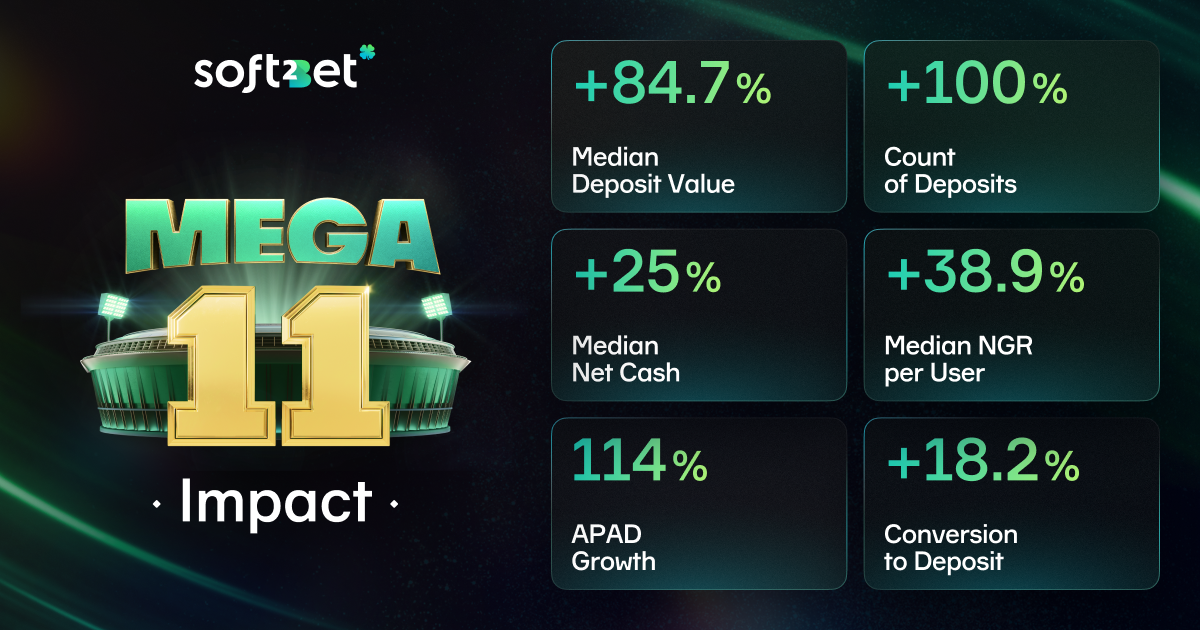
The results speak for themselves. Soft2Bet reports that the MEGA portfolio has delivered on average a 65% uplift in net gaming revenue, a 45% rise in average revenue per user, a fourfold increase in screen time, 50% higher deposit amounts and a 30% rise in deposit frequency.
Leaders’ vision: Why MEGA11 was created
Player activity inevitably rises around fixtures, major tournaments and high-profile matches before dropping when a match is over, a favourite team exits, or the tournament moves on. A fan who opens an app for a World Cup run may place a bet, check the result and not return until the next major fixture.
At that point, CRM pushes, bonuses and event-led campaigns become all-important as operators seek to re-engage players. With this in mind, MEGA11 was created to give players a meaningful reason to return.
“MEGA11 is built to keep football fans engaged between matchdays by combining real betting with social gameplay,” Zuckerberg says. “It gives operators a way to turn the time between matches into part of the sportsbook experience. Players manage a squad, compete, progress and return for football-related reasons.
“Retention is moving into the product layer, with progress, missions, social features and segmentation giving players clearer reasons to return. For sportsbook and casino operators, that means building products that give players a reason to come back before the next promotion is sent.”
How operators can maximise engagement
The first step of maximising engagement is to build journeys around player intent, Zuckerberg adds. For example, a newly verified football bettor does not need the same journey as a regular accumulator player, a dormant sportsbook customer or a casino-first player who only enters sports during major tournaments.
MEGA gives operators configuration tools for rewards, bonus triggers, user segmentation and difficulty levels, helping product teams shape journeys around real player groups.
The second step is to add missions and tournaments without compromising platform speed. MEGA works as a standalone product that integrates through a simple API, allowing operators to add gamification engines to existing casino and sportsbook activity without disrupting processes or requiring a full platform rebuild.
The third step is to optimise campaigns while they are live. MEGA11 dashboards give product and retention teams a way to track cohort data, repeat-deposit rates, wagering frequency, session activity, reward response and reliance on incentives in real time.
‘For operators, it creates more reasons for players to return without relying only on bonus-led campaigns’
Soft2Bet’s CAC and LTV analysis recommends measuring the retention of cohorts after one day, seven days and 30 days alongside repeat deposit rate, wagering frequency and net revenue retention. “With that information, MEGA11 dashboards can help teams adjust campaign rules, rewards and communication before a cohort falls behind its payback target,” Zuckerberg explains.
A B2B engagement layer
MEGA is built for operators that want to add stronger engagement tools without replacing their existing platform. Its API-based set-up allows casino and sportsbook teams to add gamification engines, missions, rewards, segmentation and player progression to their current product flow.
“For product and retention teams, the value extends beyond the player-facing game,” Zuckerberg says. “MEGA gives operators more ways to test journeys, adjust rewards, manage difficulty levels and measure which player groups respond to different engagement formats. That makes it easier to connect gamification with cohort behaviour, session depth, repeat visits and long-term player value.
“MEGA11 applies that same logic to sportsbook engagement. A football-led journey gives players squads to build, competitions to follow and progress to track between fixtures. For operators, it creates more reasons for players to return without relying only on bonus-led campaigns.”
A longer player journey
MEGA gives Soft2Bet a range of gamification engines for casino and sportsbook brands. According to Zuckerberg, MEGA11 brings that strategy into football betting, turning routine sportsbook activity into a longer player journey.
“MEGA11 makes the sportsbook experience more active between fixtures,” he adds. “Players build squads, compete, progress and return. Operators can connect that activity to progression, rewards and behavioural data. Standard betting activity can become a more active player journey, giving operators a practical way to improve session time, return frequency, GGR and long-term player value.”
As Zuckerberg points out, “attention costs more to acquire”, making it increasingly important for retention to be built into the product. Given this, MEGA11 is enabling operators to keep players active between bets, fixtures and campaign moments, ensuring football’s relentless appeal extends beyond the final whistle.