
Resolution revolution: Why customer service must move beyond containment

The AI revolution should be ushering in a golden age for customer service. Instead of worrying about spending hours on hold when they need assistance, customers should now approach their service providers with confidence that an AI agent will be available around the clock, respond instantly and have all the information needed to resolve their enquiry.
Too often, however, the reality falls short of that promise.
To that customer requiring help, automation can appear designed to contain enquiries and keep them away from human agents rather than deliver genuine resolution. Yet should that disgruntled customer abandon their quest and just put up with their problem after yet again being coldly redirected to an overlong FAQs section, this unsatisfactory encounter may still be recorded as a success by the operator. That risks repeat contacts, customer churn and, in gambling, missed signs of financial distress or responsible gambling concerns, creating potential player protection and regulatory risks.
New Jersey-headquartered Raphie has made true resolution and “accountable automation” central to its iGaming-specialist AI platform since it was founded as Conduet in 2019. The platform’s expertise is built on more than one million real industry interactions, enabling the technology to use industry knowledge and account context to establish what has happened and what action is required.
“A big premise on which we have built Raphie is to completely avoid that situation where it feels as though you are talking to a robot that does not know what you are asking,” says co-founder and chief executive Justin Heath.
The success of Raphie’s resolution-led approach is clear, with one US sportsbook client recording customer satisfaction scores above 90% among players being helped by its fully automated service. Results of that kind, together with Raphie’s industry expertise and the opportunity to help operators reduce costs without compromising service quality, now underpin an ambitious move into European markets.
Why generic AI reaches its limits
Central to Raphie’s European push is the evidence that generic AI systems are not equipped to resolve many of the specific enquiries generated by an iGaming operation.
According to Raphie, around 90% of incoming contacts in iGaming require account-specific information, yet too often a player asking about, for example, a withdrawal’s status may well instead be fobbed off with the operator’s general payments policy. Actual resolution of the enquiry may instead require the technology to identify a fraud or risk review, request further documentation or provide an accurate payment timescale.
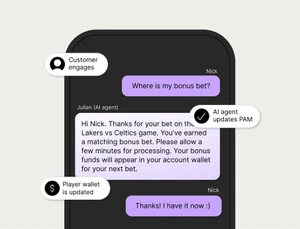
The same applies to questions about bet settlements, bonuses and game rounds. A generic system might recognise that a player is querying a parlay but lack the industry knowledge and wagering data required to break down its individual legs and explain why the bet lost.
Raphie addresses that gap through what it calls a “context layer”, integrating with the operator’s player account management, wagering and customer-service systems. This allows the platform to retrieve the relevant information before applying the operator’s procedures to the response.
Heath says Raphie has seen operators initially dismiss the need for a specialist platform because their existing helpdesk already included an AI tool. However, there is often a dramatic gap between these generic services’ advertised promise and live performance.
“Operators will tell us they are using Salesforce or Zendesk and already have an AI tool available,” he explains. “They expect the 70% or 80% automation advertised on the box, but then find it is more like 5% or 10% because that is the volume you can respond to without the wagering-technology integration.”
Putting true resolution to the test
Raphie’s alternative is not an all-or-nothing switch from people to automation. Its three modes can be deployed independently or blended according to the operator’s needs.
Full Automation uses the Raphie AI Agent to resolve supported interactions end to end, with appropriate handovers when human intervention is required, while Co-Pilot supports human agents by providing suggested responses, which can be used as written or edited. Operators can also use Raphie’s Specialist Human Agents in Jersey City and the Philippines as a standalone service covering customer service and risk and payments support.
“We assess where a customer has dropped off before the conversation has fully run its course rather than treating that as resolved.”
Arkansas sportsbook BetSaracen demonstrates how Raphie’s AI modes can work together. The operator began using Co-Pilot more than a year ago and introduced Full Automation more recently. Over its first eight weeks, Full Automation delivered a 77% autonomous resolution rate and reduced response times by more than 55%. Crucially, customer satisfaction remained above 90%.
The resolution figure is not calculated simply by counting every conversation that ends without a human handover. Raphie considers customer satisfaction, whether an agent had to intervene and whether the player made contact about the same issue again within 24 hours. It also uses large-scale quality assurance to identify conversations that were abandoned before reaching a proper conclusion.
“An abandoned conversation is a very negative outcome,” Heath explains. “It means the customer has been going around in circles or has not received the response they need. We assess where a customer has dropped off before the conversation has fully run its course rather than treating that as resolved.”
For Raphie co-founder and chief operating officer Alex Jones, the way some customers interact with the AI Agent provides another indication of the quality of the experience.
“They do not know they are talking to an automation tool,” Jones says. “We see people wishing Raphie a good night and signing off because they have enjoyed such a natural dialogue.”
From controlled rollout to wider automation
Raphie recommends a controlled four-stage process for operators introducing automation. It begins by assessing the operator’s enquiries and workflows before moving into shadow mode, where responses are tested without being sent to players. Automation is then introduced category by category, followed by continuous optimisation as products, promotions and player behaviour change.
“We usually start with a narrow automation scope and then expand it as we prove the resolution and the human-like response,” Heath says.
“European markets are under far more cost pressure, so the desire to move quickly with AI seems to be there.”
That gradual approach allows operators to increase not only the number of enquiries Raphie handles but also the actions it can take to resolve them. A bet-settlement enquiry might reveal that an event has finished but the market remains unsettled, allowing Raphie to alert the trading team while updating the player. It can also notify a game provider about a stuck round or unlock an account when the operator’s approved criteria have been met.
Even as its remit expands, Raphie recognises that resolution sometimes requires human intervention. Enquiries are handed over when they fall outside the approved scope, the customer becomes agitated or the conversation raises responsible gambling concerns.
“If somebody asks about a pending withdrawal and then says they need the money to pay their rent, that type of flag is escalated straight through to the relevant team,” Heath explains.
Towards accountable automation in Europe
The balance between greater autonomy and clear human intervention is central to what Raphie describes as “accountable automation”. The ultimate goal is not simply to maximise the number of conversations handled without an agent, but to ensure decisions are measurable, auditable and made within an operator-approved scope.
As the technology develops, Raphie expects AI to resolve a broader range of enquiries and take more of the operational actions required to complete them. Human teams can then concentrate on complex or sensitive cases, while retaining oversight whenever judgement, player protection or regulatory responsibility demands it.
Having established its model in North America, Raphie is now looking towards European expansion. That will not involve simply transferring the same approach from one continent to another. Raphie describes Europe as a regulatory patchwork in which its underlying understanding of payments, bonuses and KYC enquiries may remain relevant, but the compliance and escalation layer must be adapted market by market. Player-protection rules, responsible gambling triggers, disclosure requirements and audit expectations can all differ between jurisdictions.
European operators already run sophisticated customer-service operations, supported by experienced teams with a detailed understanding of the challenges involved. However, rising gambling taxes and other pressures are prompting operators to reassess their cost bases and how people and technology are deployed, as they seek greater efficiencies without compromising the customer experience. Raphie says that its service can reduce customer support costs by more than 60%.
Heath says: “European markets are under far more cost pressure, so the desire to move quickly with AI seems to be there. We are seeing interest from small operators right through to some of the biggest globally.”
Through its European expansion, Raphie can help iGaming operators in mature markets solve more customer problems at lower cost, while reserving human expertise for cases that genuinely require it. For players, the difference should be equally clear: fewer circular conversations and, finally, resolution rather than rage.