
Why trust must underpin the next era of affiliate marketing
For readers who don’t know iGaming.com, how would you describe what the company does today?
At its core, iGaming.com is an affiliate and media business. We help players find operators that are safe, licensed and worth their time, and we help operators reach the right audiences.
Before iGaming.com, you spent over two decades in other industries, including CEO roles in multinational companies in the aerospace, automotive and power tools sectors. Can you share a memorable moment from that part of your career, and what does that outsider’s lens let you see that lifelong gaming executives might miss?
To cite one memorable moment, I once gave a TV interview standing on a wing of Air Force One – the American aircraft that brought Kennedy’s body back after he was assassinated in Dallas.
This was part of an advertising campaign for polishing tools. Many companies can make good tools. But only one company can stand out by being the first to use Air Force One. This campaign made the tool one of the best-known in the US. We could tell a story. We added an emotional element to a technical product. Branding was as important to the product’s success as its quality.
In manufacturing, quality and safety are not marketing slogans; they are the licence to operate. A faulty product doesn’t just cost you a sale; it costs you the trust of customers who inspect what you ship. I brought that mindset with me. In gaming there is still a reflex to treat player protection as a cost or a compliance burden rather than as the foundation of the business. Coming from outside, I also find it easier to question habits that insiders accept as given – especially the assumption that growth and responsibility pull in opposite directions. They don’t, if you build the company correctly.
Your last iGaming Germany talk was entitled ‘Ethics at stake: Can the gambling industry play fair?’ So, can it?
It can, but only if it stops pretending the question is awkward. Playing fair is good business. A big myth in gambling is that ethics and profits are enemies. In reality, unethical profits today are usually future losses waiting to happen.
For an affiliate, the rule is simple to state and hard to live by: you never send a player somewhere you wouldn’t send a member of your own family. That means promoting licensed operators, being honest about terms, and not optimising for the vulnerable. The temptation in our model is that the most profitable short-term keywords are often the least responsible ones.
And let’s be honest. Choosing to forgo that revenue is an ethical decision for each affiliate business. The risk of being caught and penalised is low. You deliberately leave a portion of your accessible market to illegal affiliates and operators. This means less profit, less tax, fewer legal jobs and possibly less player protection. Players using illegal operators cannot rely on the protections required in the regulated market.
On the iGamingCare podcast with Mindway AI you discussed AI for safer gambling. Beyond the hype, where is AI genuinely moving the needle on player protection, and where is it still oversold?
Where it genuinely works is behavioural detection. Tools like Mindway AI can read patterns of play that a human reviewer would never catch in time, and flag a player drifting towards harm early enough to intervene. That is real, it is operational today and it beats waiting for someone to self-report. Where it is oversold is the idea that AI is a complete solution you can switch on and forget. It is a smoke detector, not a fire brigade. It still needs trained people, clear escalation paths and a culture that acts on the alerts rather than burying them.
Similar technology powers smarter acquisition and personalisation. Do operators and affiliates risk using AI to optimise against players’ interests?
Yes, and pretending otherwise would be naive. A model capable of identifying a player at risk can identify a player who is easy to push. That is the central ethical tension of AI in our industry. We guard against it by drawing a hard line: behavioural data is used to protect, never to exploit. We don’t build segments that target signs of vulnerability as a selling opportunity. That commitment has to be written into the brief, owned by someone senior, and open to audit. If conversion is the algorithm’s only objective, it risks targeting vulnerable players unless explicit safeguards are built in. You have to constrain it deliberately.
At a recent conference you spoke about AI and affiliate marketing. What was your message for a market where gambling advertising is so tightly restricted?
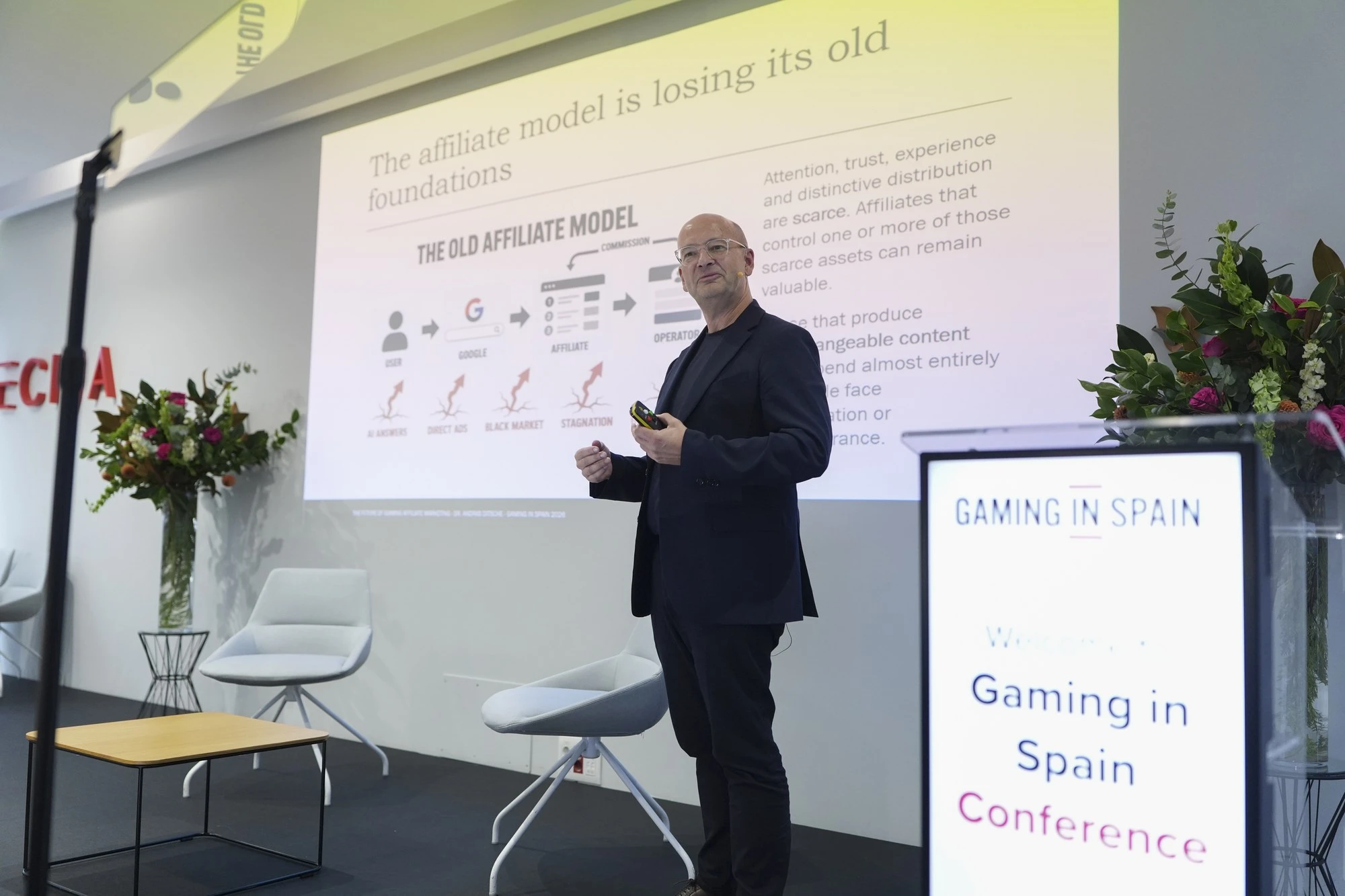
The affiliate model is losing its old foundations. The middleman will die unless he adds perceived value. The chain from Google search to affiliate page to operator is under pressure from every side: AI answers, operators buying traffic directly, the black market and stagnating search. Attention, trust, real experience and distinctive distribution are now the scarce assets. Affiliates that control one of them stay valuable; those producing interchangeable content will face consolidation.
In markets like Spain, where advertising is tightly restricted, affiliates can help direct players towards legal product offerings. This is challenging because channelisation is not only about advertising; it is also about the product, which the affiliate has limited influence over.
Another challenge is the reader’s attention span. Texts are scanned, at most, rather than thoroughly read. Often, people just look for the conclusion, not the reasoning. Mr Spock might have the data, but the storyteller has the audience.
You spoke at a corporate social responsibility conference outside the gambling industry in June. Can you elaborate on that experience?
I spoke about responsible leadership in morally contested industries at a scientific conference hosted by the University of Limerick. Such occasions do not come often, because the gambling industry and academia often keep a distance. Actually, I was there in my capacity as a university professor of management who also teaches ethics.
Our interview today focuses on the activities of an affiliate in a highly regulated marketplace. My focus at the conference was the inside view – how do you lead people in a company operating in an industry that does not come with a natural and widely accepted purpose? The discussions we had were mind-blowing!
iGaming.com Group now includes Relevo, the Spanish sports title. A few weeks into the 2026-27 season, what has running a newsroom taught an affiliate business about trust?
That trust is earned in public, every day. You can refine a comparison page quietly over months. A newsroom publishes many times a day under real names, and readers notice immediately when something is wrong. That discipline is good for an affiliate business to sit next to.
It has also taught us about loyalty. Sports fans come back to Relevo because of the people writing, not because a search engine sent them. A voice readers trust is a scarce asset, and you cannot rent it from Google. We are still early in the 2026-27 season, so the rest of the season will be the real test.
Of all the changes you highlight, which one presents you with the most concern in terms of how it could develop over the next 12 months?
What worries me is AI being deployed faster on the acquisition side than on the protection side, so the industry gets better at finding players before it gets better at safeguarding them. The technology is the same. Which use case we fund first is a choice, and it is the choice that will define the next decade.

Professor Dr Andreas Ditsche, CEO, iGaming.com