How trading teams can shape African sportsbooks

On social media, if you scroll beneath posts from European betting operators, rarely would you describe the comments as “genial.” But do the same for their African counterparts and you likely would.
African bettors appear to enjoy a more cordial relationship with bookmakers; the overall experience extends beyond the bet itself.
Trading teams should embrace this personable approach, without letting the friendly spirit obscure subtle risks.
Taking a punt
In the past, poor banking infrastructure, limited connectivity and regulatory uncertainty provided barriers for African bettors. And in countries such as South Africa, the dominance of spreadbetting, often requiring significant sums to cover risk, excluded casual punters.
In many markets these barriers have reduced. African bettors have mobile access to an abundance of markets – and most can deposit instantly. As a result, the African sports betting and iGaming market could be worth $22 billion GGR by 2029, according to H2 Gambling Capital.

Football is undoubtedly the continent’s most popular sport, and this is reflected in betting behaviour. “The customer base places the same bet every weekend. Barcelona, Manchester United, PSG; big European favourites to win,” says Jon Russell, a senior betting consultant.
Russell observes that “you’re not holding 50,000 independent bets; you’re holding one bet with 50,000 stakes on.” Operators familiar with European markets, where wagers are generally more spread, may underestimate this concentration risk.
While the beautiful game reigns supreme, a solid European football offering alone is not enough to succeed.
Crash games, such as Aviator, are popular in Africa. Designed for mobile, these speedy money multipliers provide a simple alternative to traditional sports betting. The gripping game mechanics and big wins fuel online conversation. Russell notes that they “didn’t arrive because operators pushed them; customers made them popular.”
While crash games found their place in the modern world, other markets rely on legacy. “You’re not getting anywhere pushing horse racing in Nigeria,” warns Russell. However, in South Africa, the sport has deep roots, which means it’s an essential offering.
To succeed, operators should therefore watch what their customers are doing; rather than deciding in advance how an African sportsbook should look.
Multiples, multiples, multiples
African bettors have distinct gambling preferences. Drawing on his trading experience, Tim Smeets, a senior betting consultant, observes, “In Europe, Kambi allowed 12-24 legs. That system wouldn’t work in Africa; at Kingmaker we had 40 folds, with requests for 50 folds.”
For many in the region, the prospect of turning a small stake into a life-changing win outweighs the cold, hard logic of margins. Effectively these long multipliers are analogous to a “lottery ticket with a football theme,” according to Russell.

While multiples need to defy significant odds, bettors aren’t just rolling the dice.
“Customers will look on the homepage for odds ranges,” Smeets tells iGB. He goes on to explain that “They’ll click on the statistics and do their research.” So, while it’s the price that initially piques bettors’ interest, a football-smart audience requires information to reaffirm selections.
Fine margins
In North America and Europe operators compete on margin. They use pricing to attract customers, often in a race to the bottom, while offering regular promotions to assure customers they are getting the best value.
This strategy would be a mistake in Africa. “I don’t think there’s a big percentage of customers who know how to calculate margins,” Smeets reckons. Arguably while there is less price sensitivity compared with other regions, he warns against egregious margins, “with over/unders, for example, you only have two outcomes. If we offered worse results on both sides than a competitor, it would be easy to spot.”
The extent to which pricing matters also depends on market maturity. South Africa, for example, is competitive, forcing operators to either compete on product or price. In contrast, less competition exists in newer markets, such as Morocco, with players generally more unfamiliar with betting margins.

Smeets draws on his experience at BetKing to illustrate this: “When we started in Nigeria we were super aggressive to grow market share. But we didn’t feel that it made a huge difference in how we were perceived.” Smeets acknowledges this led to a change in pricing strategy: “Let’s put ourselves on the podium, but no more than that.”
Trading teams still need to display sound fundamentals. Mispriced markets can be exploited, but in Africa there are different dynamics in play.
“I’ve watched African punters find a mispriced Esports market and relay this in message boards and WhatsApp groups, hammering the market in minutes,” explains Russell. While in other regions, it’s mainly one sharp customer placing a big stake, in Africa it’s often small bets from hundreds of bettors.
This presents a problem to trading teams. One savvy bettor can be restricted, whereas limiting the bets of hundreds of recreational players is punitive and impractical.
Going even bigger
Players with a limited understanding of betting margins may be more responsive to headline bonuses. It’s a simple way to communicate value to bettors who may struggle to realise the competitiveness of their odds.
With this in mind, operators in Africa tend to offer accumulator bonuses – turning already huge wins into stratospheric ones.
The high payouts may alarm operators, but they should not be deterred. “The bonus looks generous, but it’s not. A 10% uplift on a 15-fold is essentially a rounding error,” Russell adds.
Bettors are still up against a huge margin, so the additional value is negligible. Operators can lean into compelling headline offers, with eye-catching numbers, while giving up little in return.
Community spirit
Betting in Africa is often a communal experience, ranging from lively retail outlets to WhatsApp and Telegram groups. The bet can be as much about participation as profit.
Online tipsters reinforce this dynamic, with bettors sharing picks, debating games and celebrating wins together. The most successful tipsters have substantial online followings – MrBanks, a tipster from Nigeria, has more than 2 million followers on X.
And these communities affect trading books, particularly when tipsters partner with operators. Smeets explains that, “Tipsters share accumulators, which could be 30-folds. Their followers then copy and paste booking codes into your platform – and there you go.”
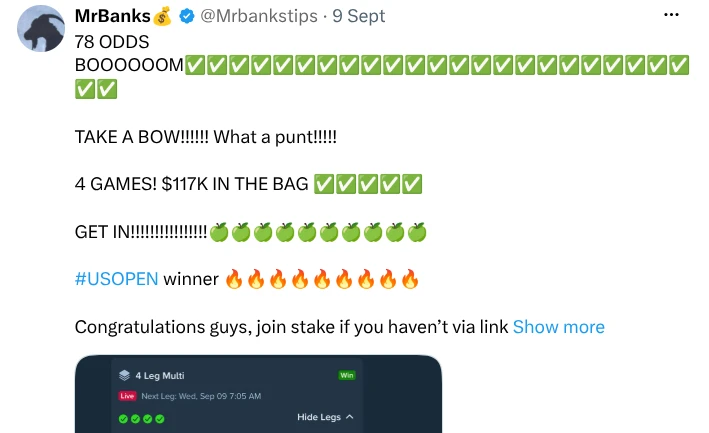
A significant number of African bettors follow tipsters, so it’s essential for operators to accommodate this functionality. If not, they will choose a competitor where they can easily get the bet on, with the flexibility to add their own selections.
The joviality in these communities extends to every touchpoint with the operator. As Russell notes, “The interaction between the punter and the bookie on social media is entertaining. It’s genuine, good-natured ribbing.” He contrasts the dynamic in Europe where “It’s just a stream of insults and accusations of theft.”
Operators should avoid appearing combative, as if they are in a zero-sum game with every customer. In fact, they would be advised to lean into customer wins, as with SportPesa, who routinely feature jackpot winners on their blog.
Goodwill is built from the grassroots up. BetKing’s outreach programme demonstrates how operators can build community ties beyond betting, delivering healthcare, nutrition and humanitarian support to communities across Nigeria.
As Russell puts it, “Creating brand loyalty is essential. Think about it as Team Betway or Team Hollywoodbets; a community rather than a group of individual punters. That’s the most significant difference between the customer bases.”
Edge versus hedge
Betting communities create risk around a narrow set of outcomes. When thousands of bettors follow the same advice, operators face correlated exposure rather than thousands of independent bets.
You need to map out the doomsday scenario for the Saturday fixtures. What happens if the top 35 teams win? How much will we lose?
Accumulators amplify this as huge payouts could hinge on the result of a single game. Operators need to have strategies to deal with this level of risk – and the stomach to deal with lopsided books.
Russell emphasises the importance of long-term thinking. He says “At the end of the year you’re going to make a return from these bets. It will be a roller coaster; some weekends you make 50%, other weekends you lose 200%.”
While probability favours bookmakers in the long term, trading teams should not just sit back and rely on the margin. Smeets warns that “the likelihood of 30 folds coming in is extremely low, but it’s never zero. If you’re not aware of liabilities, it could be a recipe for disaster.”
Smeets advises that risk planning should be conducted way in advance of crucial fixtures. “You need to map out the doomsday scenario for the Saturday fixtures. What happens if the top 35 teams win? How much will we lose?”
The complexity of so many accumulator combinations makes the risk difficult to mitigate. Even specialist risk-management firms struggle to hedge big accumulators with long odds and high payouts. Individual legs are hedgeable, but this would mean sacrificing precious margin.
Standard bookmaking practices such as payout caps and stake limits are options. However, in this market the most critical tool for operators is the cash-out function. It offers bettors the chance to lock in a smaller payout, yielding equity to the operator. Funds are instantly deposited into players’ accounts, giving them the chance to place more wagers.
In addition, the popularity of pre-built accumulators enables trading teams to spread risk. As Russell explains, “Make sure you vary them. Include Milan in one, but leave them out the next, and add PSG. Build your construction tools that add diversification into them.”

Built differently
Betting habits should shape product design from the ground up. Successful operators adapt to market nuances – rather than producing generic models.
“In Europe, the tendency is to go big, give loads of options and create different journeys,” says Smeets. He cautions against this approach in Africa, arguing that too much choice can overwhelm bettors, creating unnecessary friction.
The challenge is to balance familiarity with modernisation. Bettors want intuitive journeys that feel recognisable, but operators must conveniently introduce sleeker interfaces, smarter tools and new features.
This tension is particularly acute in Africa. Smeets observes: “Customers have a specific journey: 4 clicks and that’s it. Suddenly if this turns into 5 clicks, that might be the difference between retaining the customer and losing them.”
Keeping the betting journey simple
Fewer clicks, less friction
- Design around local betting habits, not generic models.
- Keep journeys simple: extra clicks can cost customers.
- Fast payments, cash-out and low latency are essential.
- Pre-built accumulators reduce friction.
- Free data is now a competitive necessity.
For operators in the region, certain features are essential. A price-range filter enables customers to begin their research, a low-latency product supports the smooth construction of multi-leg accumulators and speedy withdrawals ease concerns around payment reliability. Cash-out functionality is non-negotiable.
Many bettors want to mirror the selections of their friends, without the hassle of scrolling through a long list of prices. Operators can placate these customers with pre-built accumulators – turning dozens of clicks into 3 or 4.
Product functionality is only part of the equation. Providing free data is an expense, but it is a necessary investment to remain competitive. As Russell explains “Betika started it in Kenya with their bundles, and that spread to Ghana, South Africa, Nigeria, and Zambia.”
Now major operators, such as Betway and Hollywoodbets, run similar models. Russell observes, “Operators are essentially paying for their own distribution networks. I don’t think that exists anywhere else in the world.”
Protecting the book
Africa only accounted for 11 of the 76 suspicious alerts recorded in IBIA’s Q2 2026 report. However, these low numbers may reflect differences in detection and reporting capabilities.
“European fixtures have multiple data sources. Some domestic African fixtures rely on very little information,” notes Russell. He points out that “You cannot detect a manipulation against a data source that can itself be easily manipulated, if you’ve only got one individual source.”
And this is where technology is crucial. It can analyse thousands of bets simultaneously, identifying patterns that trading teams could easily miss. Unusual betting activity can be brought to light.
Betting tendencies in Africa also reinforce the need for sophisticated identification tools. With a constant stream of low-stakes, multi-leg wagers, a suspicious £200 bet on third division Russian handball is hard to manually detect.
It can also be hard to spot professional groups, often operating in Asia and Eastern Europe, who target generous bonuses and light verification checks. They can acquire accounts at scale, with SIM cards registered to other individuals, which are distributed across organised networks.
To counteract these practices, Russell suggests “Device and network fingerprinting, alongside behavioural clustering – spotting hundreds of linked accounts, without an obvious shared identifier.” Omitting these safeguards will leave operators exposed to co-ordinated fraud.
Heavy-handed regulation has often followed from where the industry has failed to regulate itself
— Jon Russell, senior betting consultant
While it’s important to protect the book from nefarious actors, it’s also essential to protect legitimate bettors from developing unhealthy habits. With regulation uneven across the continent, and in some places non-existent, Russell argues there are lessons to learn from Europe: “Heavy-handed regulation has often followed from where the industry has failed to regulate itself.”
Operators must therefore get ahead of potential changes. This means embedding responsible gaming tools into products, signalling to regulators that customer welfare is a priority. If operators act passively, measures will likely be imposed on them; it’s better to shape regulation, than be shaped by it.
What operators overlook
Regional nuances need to be at the heart of strategy. The challenge is turning local insights into a sportsbook built for each market.
In South Africa online sports betting is legal, but online casino isn’t. This would prohibit a common customer journey, as Russell points out, “Many European marketing campaigns are based on cross-sell; get them in on sports and push them towards casinos.”
Some countries are heavily reliant on a single payments provider, as with M-Pesa in Kenya. Operators must ensure payment infrastructures can handle constant flows of small deposits and withdrawals without disruption. If not, payment friction will undermine the entire customer experience.
More broadly, international operators may be reluctant to offer markets where they have little expertise. But, as Russell explains, this is a great opportunity: “Be aggressive where it’s most visible and least costly; cut margins on local leagues.”
In these niche areas, competition will be thinner – but so will coverage from data providers, such as Genius Sports or Betradar. Operators must price games in-house.
In doing so, Russell advises keeping margins at 2% – but with low limits. As he explains, “You can advertise the prices, knowing you will only be holding a small amount of money on the outcome.”
With in-play management, a more hands-on approach can be used, compared with Europe. If, for example, there are suspicious bets, Russell advises traders to “Pull the price, cap the payout, suspend the market – no-one takes it personally.”
In Russell’s experience, African bettors have a greater tolerance of market suspensions, compared with gamblers in other regions. This points to a wider appreciation of the overall experience, rather than one particular facet of gambling. As Smeets puts it, “The total value proposition matters more than the actual pricing.”
Key Takeaways
- Betting in Africa is often a social activity, with good-natured exchanges between operators and customers
- Influencers and online groups create concentration risks for trading teams
- Trading teams need to plan mitigation strategies well in advance of key fixtures
- A generic product will not be successful across different markets
- Among a sea of low-stakes bets, technology is essential for spotting anomalies